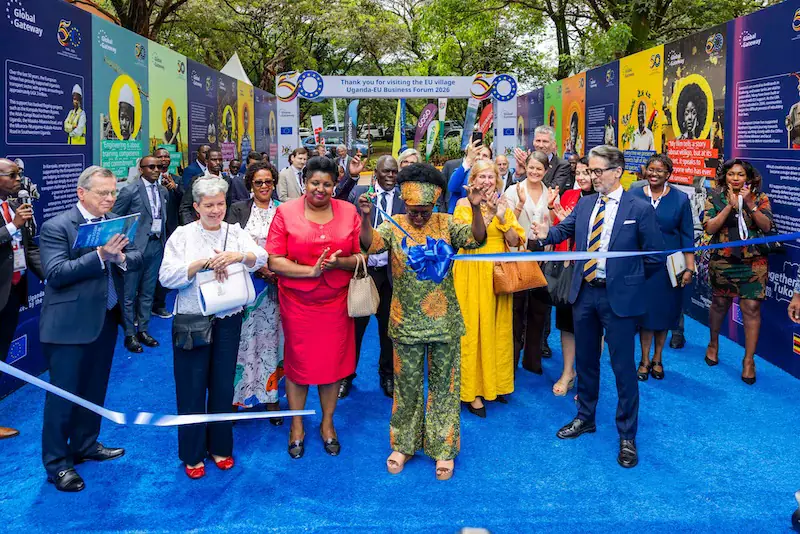
Uganda and the European Union are celebrating 50 years of diplomatic relations by reorienting their partnership towards private capital, green manufacturing, and job creation. The new focus was highlighted during the Uganda–European Union Business Forum, held in Kampala on October 20 and 21, 2026, alongside the Renewable Energy Conference and Expo. The forum brought together government officials, financiers, and business leaders to discuss ways to promote sustainable development and economic growth.
Trade between Uganda and the European Union has experienced significant growth in recent years. According to European Union Ambassador Jan Sadek, Ugandan exports to the EU have increased dramatically, from approximately €420 million in 2015 to €1.8 billion by 2025. European investments in Uganda have also been substantial, accounting for about 79 per cent of the country's foreign direct investment inflows last year, totalling roughly €2.2 billion.
The partnership between Uganda and the EU relies on Europe's "Team Europe" and Global Gateway strategy to mobilize funding for sustainable projects. A notable example is the upcoming €170-million-overhaul of the ageing Nalubaale and Kiira hydropower stations, backed by EU grants and development loans from the European Investment Bank and the French Development Agency. These efforts build on past milestones that have added roughly 500 megawatts of clean energy to the national grid.
The transition to green energy and private capital brings distinct challenges for local businesses. Sarah Kagingo, deputy chairperson of the Private Sector Foundation Uganda (PSFU), emphasized that expanded generation capacity means little if electricity remains unreliable or unaffordable for everyday manufacturers. She called for financial models that combine grants, concessional loans, and patient capital, along with structured tracking mechanisms.
Minister of Energy and Mineral Development Monica Musenero Masanza urged European investors to look beyond environmental compliance, framing renewable energy as a catalyst for industrial growth, local manufacturing, and value addition. She highlighted that Uganda's strategic position within the East African Community offers international investors a gateway to a broader continental market.
The success of the partnership will be measured by how effectively green energy investments translate into affordable power, thriving local enterprises, and employment across Uganda. Organizers and participants will monitor whether the business-to-business matchmaking sessions and project pitches from the October conference yield financed projects. The ultimate goal is to connect three million citizens to electricity by 2030.
The shift towards green jobs and private capital is crucial for Uganda's economic growth and development. With the right financial models and tracking mechanisms in place, the partnership between Uganda and the EU has the potential to create stable employment and reliable livelihoods for ordinary Ugandans, while promoting sustainable development and economic growth.
Key points
- The partnership between Uganda and the EU aims to mobilize €2.2 billion in funding for green manufacturing and job creation.
- The EU has committed to providing €170 million for the overhaul of the Nalubaale and Kiira hydropower stations.
- The partnership aims to connect three million citizens to electricity by 2030.