As of June 2026, Tunisia's budget expenditures have reached 24,917 million dinars (MD), representing 39.2% of the annual forecast and an 8.9% increase compared to June 2025. The overall execution rate, however, masks a significant imbalance in spending patterns. The Ministry of Finance's report highlights that the implementation of budget expenditures is unevenly distributed across different categories.
The report reveals that salary expenditures have reached 12,184 MD, marking a 4.9% increase and an execution rate of 48.2%. This upward trend is largely attributed to the first tranche of salary increases implemented as part of the 2026-2028 plan. The substantial allocation towards salaries, which accounts for a significant and relatively rigid portion of expenditure, stands in stark contrast to the sluggish pace of investment spending.
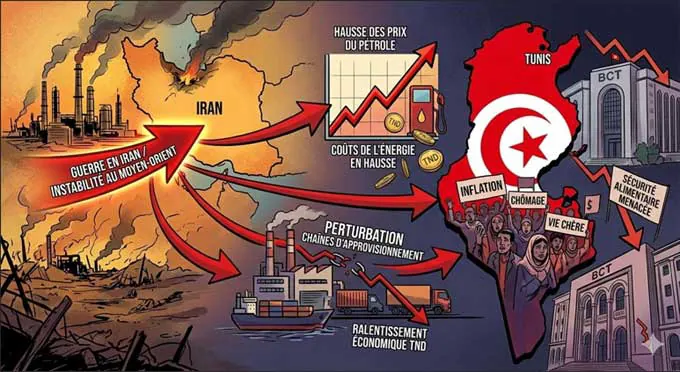
A notable concern is that fuel subsidies have surpassed public investment expenditures. Fuel subsidies have reached 2,427 MD, while investment spending totals 1,664.7 MD, resulting in a difference of approximately 762 MD. This disparity underscores the significant strain that energy subsidies place on the budget, potentially crowding out other essential public expenditures.
The execution of development-related expenditures remains a major challenge. Development spending totals 2,533 MD, including 867 MD for development interventions and 1,664.7 MD for investment. However, the execution rate for these expenditures is only 21.2%. The Ministry of Finance cites technical, administrative, and public procurement delays as contributing factors to this underperformance.
In contrast, the service of debt and revenue collection have made significant progress. The report indicates that 10,469 MD have been allocated towards debt servicing, including 6,737 MD for principal payments and 3,733 MD for interest. This represents approximately 45.4% of the annual forecast. Meanwhile, revenue collection has reached 24,195 MD, equivalent to about 46.6% of the projected annual revenue.
Looking ahead to the 2027 budget, the Ministry of Finance has outlined several key priorities. These include consolidating financial equilibria, enhancing resource mobilization, promoting social justice, and ensuring food, water, and energy security. The ministry aims to accelerate investment, modernize the state, and improve public services while maintaining a commitment to sustainable public finances.
The 2027 budget priorities are built around five main axes: consolidating financial equilibria, increasing resources through more effective and equitable taxation, maintaining the social role of the state, ensuring sovereignty in food, water, and energy, and accelerating investment and modernizing the public apparatus. The challenge for 2027 will be to translate these priorities into tangible results, particularly in light of the underwhelming execution of development expenditures in 2026.
Key points
- Development spending in Tunisia reached only 21.2% of its annual forecast as of June 2026.
- Fuel subsidies exceeded public investment expenditures by 762 MD as of June 2026.
- The 2027 budget prioritizes consolidating financial equilibria, social justice, and ensuring food, water, and energy security.