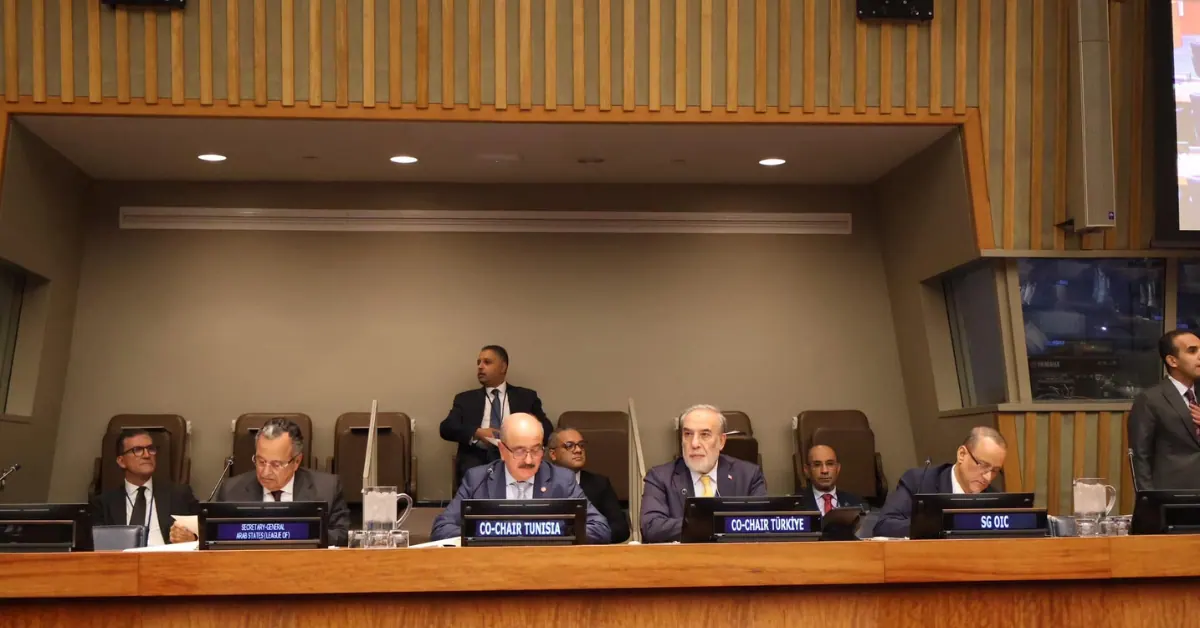
Tunisian Foreign Minister Mohamed Ali Al-Nafsi led an Arab-Islamic ministerial meeting on Jerusalem at the United Nations in New York on September 25, 2026. He emphasized that Jerusalem is an integral part of the occupied Palestinian territory and that Israel has no sovereignty over it. Al-Nafsi stated that any measures aiming to change the city's character, status, or demographic composition are null and void.
The minister reaffirmed Tunisia's commitment to the Palestinian cause, stressing that Jerusalem is the capital of the Palestinian state. He noted that the establishment of an independent Palestinian state with full sovereignty is the key to achieving a just, lasting, and comprehensive peace, in line with international legitimacy. Al-Nafsi condemned Israel's policies, including settlement expansion, land annexation, and forced displacement.
Al-Nafsi denounced the ongoing violations against the Al-Aqsa Mosque and attempts to alter its historical and legal status. He expressed concern over the escalation of provocative practices and hate speech, which threaten regional and international peace and security. The minister emphasized that protecting Jerusalem and its inhabitants is a collective responsibility.
The Tunisian minister highlighted the importance of bolstering Arab, Islamic, and international support for the Palestinian people, particularly in the areas of housing, education, healthcare, and development. He called for the protection of Palestinian heritage, endowments, and properties. Al-Nafsi also commended the role of the Jerusalem Committee and the Bayt Mal Al-Quds Al-Sharif Agency.
Al-Nafsi warned that attacks on holy sites and incitement to violence undermine regional and international stability. He stressed that safeguarding Jerusalem and its sanctities is a global responsibility, based on international law and the UN Charter. The minister urged the international community to take concrete actions to deter Israeli aggression.
Tunisia, as chair of the 166th session of the Arab League Council at the ministerial level, pledged to continue working with Arab and Muslim counterparts to protect Jerusalem and support its people. Al-Nafsi emphasized the need for sustained coordination between the Arab League and the Organization of Islamic Cooperation within the UN framework.
The ministerial meeting was held on the sidelines of the 81st session of the UN General Assembly. The Arab-Islamic meeting aimed to mobilize international support for the Palestinian cause and to address the challenges facing Jerusalem. Key points include:
Key points
- Tunisia's Foreign Minister reaffirms Jerusalem as part of occupied Palestinian territory
- The minister denounces Israeli policies, including settlement expansion and forced displacement
- Tunisia calls for sustained international support for the Palestinian people and protection of Jerusalem's sanctities