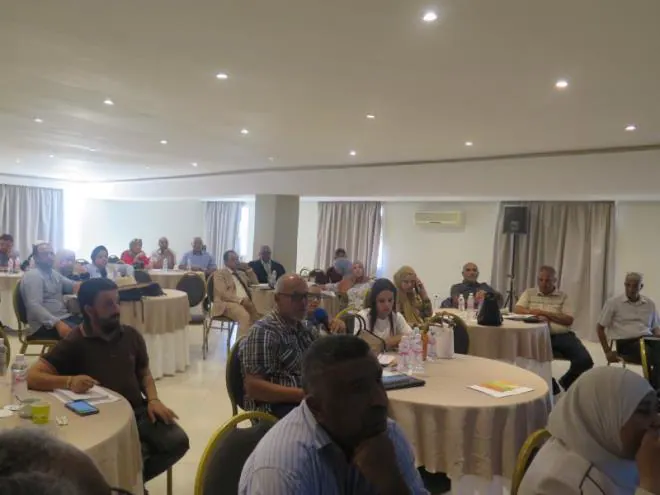
A regional workshop for information, training, and validation of the second phase of preparing the national report for 2026 on the United Nations Convention to Combat Desertification is taking place in Kairouan, Tunisia. The workshop, organized by the Sahara and Sahel Observatory in collaboration with the Ministry of Environment, brings together institutions and actors from central governorates. The goal is to enhance available data and strengthen methodological capacities related to reporting on the UN Convention to Combat Desertification.
The workshop focuses on Sustainable Development Goal 15.3.1, which tracks the proportion of degraded land compared to the total land area. Participants are discussing preliminary results related to the three components of this indicator: land cover, land productivity, and organic carbon stock in soil. The workshop combines geospatial mapping based on Earth observation techniques and local expertise to improve the identification of critical areas experiencing environmental degradation.
The event also aims to identify areas that have recorded positive developments and monitor potential data gaps. According to the Sahara and Sahel Observatory, the territorial validation phase is crucial as it provides an objective reading of recorded changes through Earth observation data. Local actors' expertise contributes to interpreting these changes in the context of land use patterns, environmental dynamics, and local specificities.
The Kairouan workshop is part of a gradual process that includes various regions of the country. Previous workshops were held in Jerjis on October 1-2 for southern governorates, and another is scheduled in Tabarka on October 20-21 for northern governorates. These regional meetings will collect and analyze territorial contributions, ultimately enabling the preparation of a national reading that considers the diversity of situations and specificities recorded on the ground.
The process will conclude with a national validation workshop, where regional contributions will be compiled, and a collective validation of data and analyses will be reached. These will be used to prepare the 2026 national report on the implementation of the UN Convention to Combat Desertification. The Sahara and Sahel Observatory is leading this effort to ensure a comprehensive and accurate report.
The national report is a critical tool for tracking progress and identifying areas that require attention. By engaging various stakeholders and incorporating local expertise, Tunisia aims to develop a robust and reliable report that reflects the country's efforts to combat desertification. The workshop in Kairouan is an essential step in this process, bringing together key actors to validate data and contribute to the report's preparation.
The regional workshops and the national validation workshop will ensure that the 2026 national report is comprehensive, accurate, and representative of Tunisia's efforts to address desertification. The report will provide valuable insights into the country's progress and challenges, informing future strategies and actions to combat desertification and promote sustainable land management practices.
Key points
- The regional workshop in Kairouan aims to support the preparation of Tunisia's 2026 national report on combating desertification.