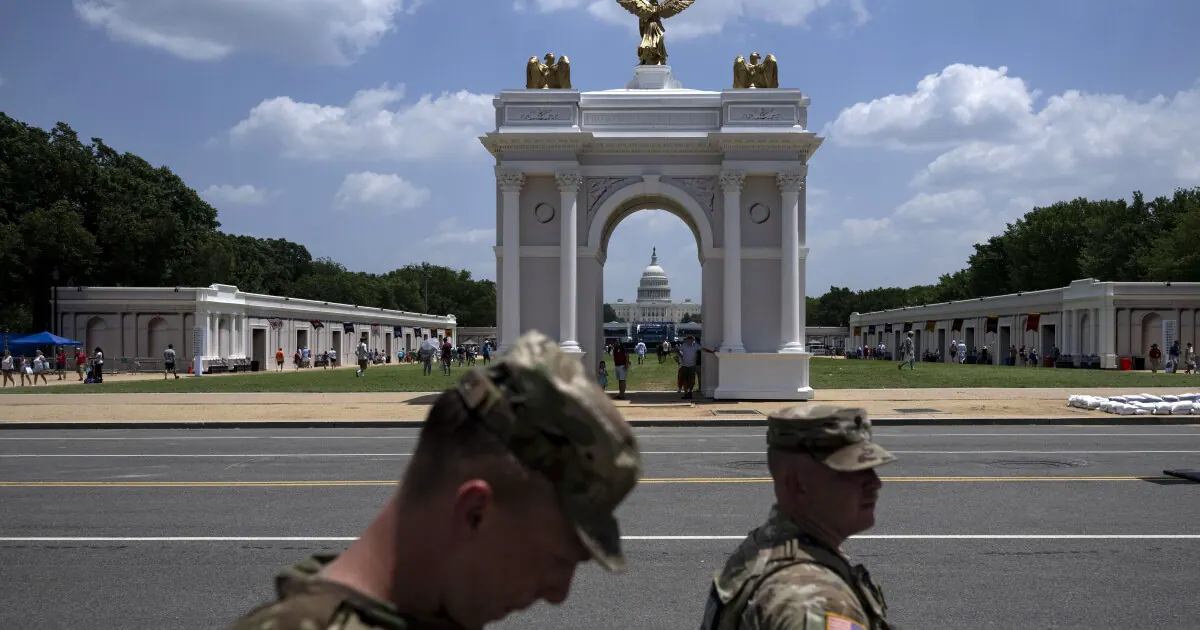
US President Trump has announced that his proposed 250-foot arch in Washington, D.C. will also serve as a "top-grade Military Complex." The structure, which Trump first unveiled last October, was initially intended to honor him and later recharacterized as a tribute to the United States' 250th anniversary and a tourist attraction. The National Park Service had touted an observation deck with views of Arlington National Cemetery and the National Mall.
The Trump administration had previously obtained approval from the Commission of Fine Arts in May for the arch, but the introduction of a military component has raised concerns. Historic preservation advocates, who had already expressed concerns over the rapid approval process, are now questioning the project's legitimacy. Charles Birnbaum, CEO of the Cultural Landscape Foundation, stated that the sudden change in purpose has brought the review process back to square one.
The National Park Service has asked preservation groups to provide feedback on a proposed Memorandum of Agreement (MOA) to move forward with the arch. However, Birnbaum has expressed skepticism, calling the MOA "dead on arrival." The White House, Interior Department, and National Park Service have not responded to questions about plans to submit new proposals for review.
The Federal Aviation Administration (FAA) had previously released findings that the arch would not pose a risk to airspace, but that review did not take into account the presence of military drones. U.S. Rep. Don Beyer, a Virginia Democrat, has expressed concerns that the drone launching site would be a "stupid, dangerous, and unworkable idea" directly in the landing path for D.C.'s main airport.
The arch project is already facing legal questions, including compliance with D.C. building height limits and a lawsuit from a group of Vietnam War veterans over its lack of Congressional approval. The administration has cited a 1925 law that allowed for the construction of a pair of 166-foot columns at the location. Trump's justification for the military complex has been met with skepticism, with Harold Hongju Koh, a former State Department legal advisor, calling it "laughable and pretextual."
Experts are questioning the national security argument for the arch, particularly given its proximity to the Pentagon and Joint Base Myer-Henderson Hall. Mark Cancian, a retired Marine Corps colonel, stated that there doesn't seem to be any articulated need for the facility to have drones and snipers. Koh believes that Trump is using the national security card to boost his case in court.
The Trump administration's use of national security justifications for various projects has been met with skepticism. The Supreme Court recently allowed construction to continue on a White House ballroom project, citing issues of plaintiffs' standing rather than the project's underlying legality. The fate of the D.C. arch project remains uncertain, with many experts believing that the administration is rushing to start construction before the November midterm elections.
Key points
- The proposed D.C. arch has sparked controversy over its military complex plans and the approval process.
- Historic preservation advocates have expressed concerns over the rapid approval process and the project's legitimacy.
- Experts are skeptical that a national security argument can be made for the arch, given its proximity to existing military installations.