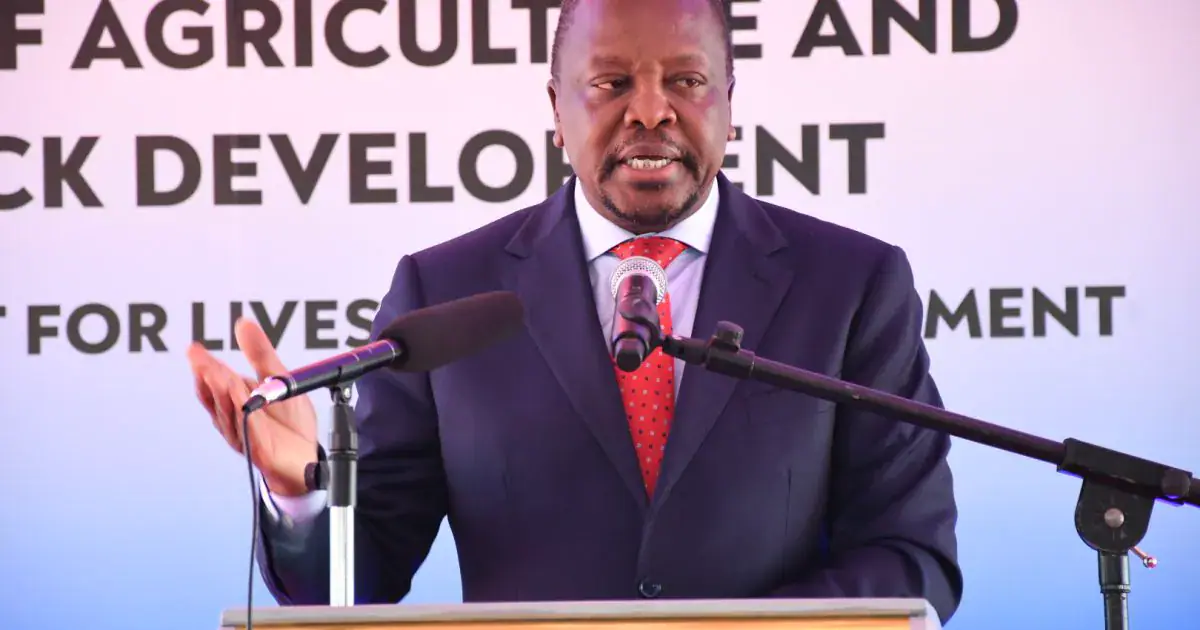
Agriculture Cabinet Secretary, Mutahi Kagwe, has emphasized the need for transforming Africa's water systems to achieve food security and reduce the continent's dependence on rain-fed farming. Speaking during the 17th Africa Day for Food and Nutrition Security (ADFNS) in Nairobi, Kagwe highlighted the importance of sustainable water management in improving agricultural production, nutrition, and farmers' livelihoods. He noted that inadequate irrigation infrastructure, water scarcity, and climate change continued to undermine agricultural productivity, particularly in arid and semi-arid areas.
The 17th ADFNS, held under the theme 'Harnessing Sustainable Water for Resilient Agrifood Systems, Nutrition Security and Inclusive Prosperity in Africa,' brought together government representatives, development partners, private sector players, and youth agripreneurs to discuss practical approaches to improving food and nutrition security across Africa. Kagwe encouraged participants to strengthen cooperation towards building resilient food systems and ensuring a food-secure and prosperous continent. He cited that only 5.7 percent of Africa's cropland was equipped for irrigation in 2023, compared to approximately 22.6 percent globally, according to the Food and Agriculture Organisation (FAO).
Kagwe stressed that water was central to every stage of food production, from seed germination and crop growth to food processing and distribution. He added that sustainable water management could improve yields while protecting the environment. The CS called for increased investment in water harvesting and storage, efficient irrigation systems, protection of water catchment areas, and measures to prevent water pollution. He also urged governments and development partners to strengthen water governance, promote safe wastewater reuse, and equip farmers with appropriate technologies and training to improve productivity.
Communities in arid and semi-arid lands needed particular support to manage water resources sustainably and adapt to changing climatic conditions, Kagwe noted. Climate change was altering rainfall patterns, prolonging droughts, increasing temperatures, and causing floods, thereby threatening agricultural production and the livelihoods of millions of farmers. The CS cited Kenya's Galana-Kulalu Food Security Project as one of the initiatives aimed at increasing agricultural production through irrigation and reducing reliance on rainfall.
The Galana-Kulalu Food Security Project, located in Kilifi and Tana River counties, covers approximately 1.75 million acres and seeks to transform dry land into productive agricultural zones through irrigation and commercial farming. Implemented through a Public-Private Partnership, the initiative aims to increase the production of staple crops, particularly maize, while creating employment opportunities and supporting agricultural value chains. Kagwe established that such investments were crucial in building national food reserves, strengthening agricultural value chains, and improving the country's capacity to withstand climate-related shocks.
Kagwe emphasized the need to integrate soil health and water security, saying the two resources were inseparable in efforts to achieve sustainable food production. He called for increased adoption of sustainable soil management practices, including soil testing, balanced fertilizer application, composting, agroforestry, crop rotation, and conservation agriculture. The CS explained that healthy soils helped retain moisture, recycle nutrients, support biodiversity, and reduce erosion, enabling crops to withstand dry spells and improving agricultural resilience.
The CS also highlighted the government's efforts to make fertilizers more affordable and accessible to farmers, citing the fertilizer subsidy programme, which reduced the price of a 50-kilogramme bag from commercial highs of between Sh6,500 and Sh7,500 to Sh2,500 initially, before a further reduction to Sh2,000 by 2026. He challenged delegates to move beyond declarations and translate their commitments into measurable improvements in food production, nutrition, and livelihoods, and called for stronger political commitment, increased investment in climate-smart agriculture, sustainable management of natural resources, and enhanced partnerships among stakeholders.
Key points
- Transforming Africa's water systems is essential for achieving food security and reducing the continent's dependence on rain-fed farming.
- Only 5.7 percent of Africa's cropland was equipped for irrigation in 2023, compared to approximately 22.6 percent globally.
- The African Union's Nairobi Declaration on Fertilizer and Soil Health provides a framework for strengthening soil fertility, improving access to appropriate fertilizers, and mobilizing investment in sustainable soil management.