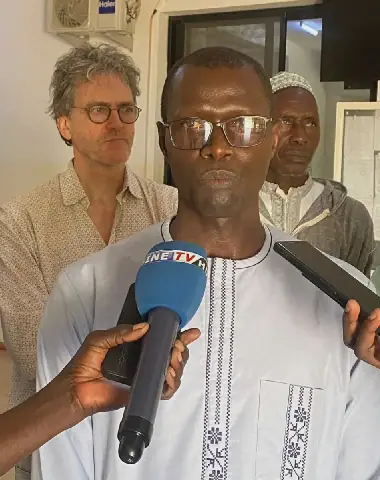
On November 2, Professor Kossi Hounaké, President of the University of Lomé and a specialist in public law, appeared on Victoire FM to discuss the ECOWAS Court of Justice's ruling on Togo's 2024 constitutional reform. He expressed his disagreement with the court's decision, questioning its competence and scope. According to Hounaké, the court's jurisdiction is limited to human rights issues, which he believes were not violated in Togo's case.
The ECOWAS Court of Justice ruled on January 29, 2026, that Togo's constitutional reform constituted a "change of government in an unconstitutional manner". However, the court did not annul the new constitution, which was adopted on May 6, 2024, nor impose any sanctions on the Togolese state. The ruling was made public in June 2026. Hounaké described the court's decision as "laconique", implying that it was brief and lacking in substance.
Hounaké argued that the court's decision should have stopped at confirming that human rights were not violated in Togo. He emphasized that the court's jurisdiction is limited to human rights issues, whether civil, economic, or political. In his opinion, the court overstepped its authority by making a ruling on a matter that falls outside its jurisdiction.
Like the Togolese authorities, Hounaké invoked the principle of sovereignty. He believes that a regional court's decision cannot be considered definitive and that there are areas of sovereignty that no state would allow to be challenged by an external entity. According to him, a court ruling, regardless of its origin, is not a definitive or absolute decision.
Hounaké also criticized a letter sent to the Ministry of Justice, which requested the implementation of the court's ruling. He described the letter as "vide", implying that it was empty or lacking in substance. He recalled that the African Charter on Democracy, Elections, and Governance does not grant the ECOWAS Court the power to impose its decisions on a state party.
The professor's comments reflect a broader debate about the role and authority of regional courts in West Africa. The ECOWAS Court of Justice has been established to promote human rights and the rule of law in the region. However, some critics argue that the court oversteps its authority and undermines the sovereignty of member states.
The controversy surrounding the ECOWAS Court's ruling on Togo's constitutional reform is likely to continue. While some argue that the court has a crucial role to play in promoting human rights and democracy, others believe that it should respect the sovereignty of member states. The Togolese government has not yet responded to Hounaké's comments, but the debate is likely to continue in the coming weeks and months.
Key points
- The ECOWAS Court of Justice ruled that Togo's 2024 constitutional reform was a "change of government in an unconstitutional manner".