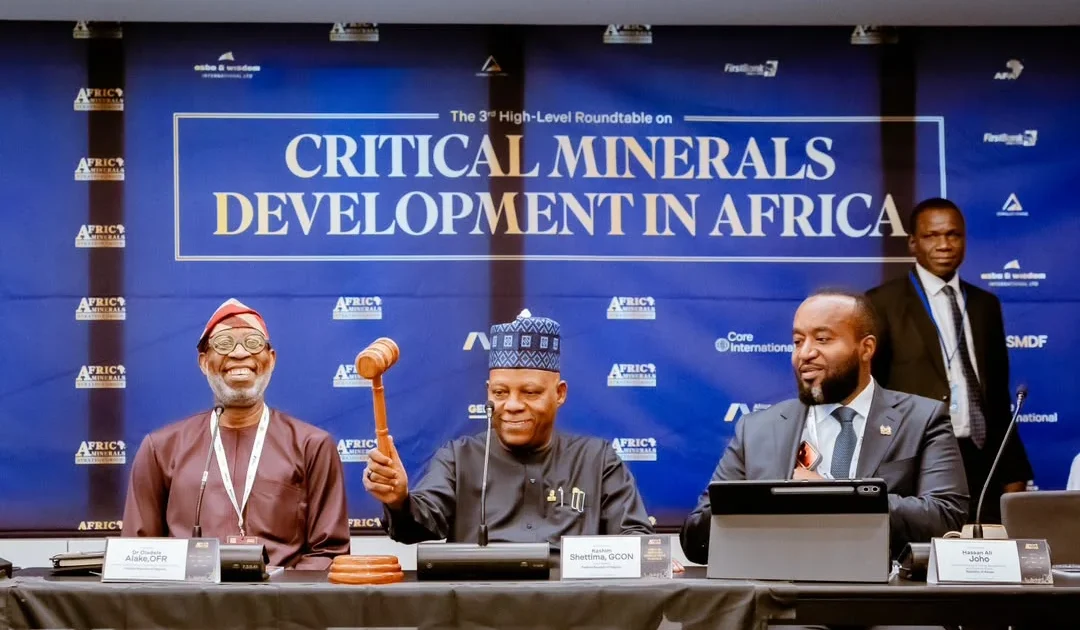
President Bola Tinubu, represented by Vice President Kashim Shettima, addressed the third Africa Minerals Strategy Group High-level Roundtable on Critical Minerals Development in Africa. The event took place on the sidelines of the 81st Session of the United Nations General Assembly. Tinubu emphasized the need for a continental push to end the exploitation of Africa's critical mineral resources. He called for African nations to unite and halt the export of raw materials, instead transitioning to a hub for local processing, manufacturing, and value addition.
The roundtable, convened and chaired by President Tinubu and AMSG Chairman Dr. Dele Alake, focused on transforming Africa's mineral wealth into sustainable economic growth. The theme of the event was "From Resources to Wealth: Continental Cooperation for Mineral Value Addition, Data Sovereignty, Innovative Financing and Critical Minerals Security." Tinubu stated that Africa cannot claim to be wealthy while its children wallow in poverty amid mines that enrich the world. He emphasized that the future being fashioned from African minerals must have room for African ambition.
Tinubu expressed regret that mineral-rich communities lack infrastructure, jobs, and a stake in their own wealth. He noted that global demand for clean energy, Artificial intelligence, and advanced manufacturing has made Africa's critical minerals indispensable to global supply chains and economic security. The Nigerian leader observed that the answer to such deprivation must be processing, refining, batteries, components, African technologies, and competitive skills.
Tinubu warned that no African country can achieve this alone, and competing through lower royalties, weaker local content, and excessive concessions would only weaken the continent's negotiating power. He emphasized that cooperation gives markets scale, industries integration, financing reach, and negotiations authority. Tinubu noted that Nigeria must require local value addition for new mining licences, strengthen geological data and investor access, organise artisanal miners into cooperatives, combat illegal mining, and improve regulatory accountability.
The Nigerian leader highlighted his administration's mining policy direction, which stipulates that minerals extracted in Nigeria must sustain Nigerian industries, workers, skills, and communities. He mentioned that revenue rose from approximately N6 billion in 2023 to over N38 billion in 2024 and between N68.1 billion and N70 billion in 2025. Tinubu also drew attention to major foreign investment commitments and large-scale lithium processing capacity developed and commissioned in Nasarawa State.
Tinubu called for reliable partnerships grounded in mutual benefit, shared responsibility, sovereign equality, and respect for African priorities. He implored member countries of the AMSG to speak with one voice to promote Africa's collective interest. The Nigerian leader insisted that reliability must never mean dependency, and partnership must never demand inequality. He also urged African nations to specify national and regional contributions and development finance institutions to propose financing platforms.
The Continental Integration and Economic Assurance Declaration was adopted and signed at the roundtable, aiming to establish a predictable, investment-ready environment for Africa's Strategic Mineral Corridors. Tinubu spearheaded an aggressive alliance to retain the continent's mineral wealth, stating that Africa's power resides in its people, markets, and ingenuity. He emphasized that no outsider will organise the continent or place African industrial interests above their own.
Key points
- President Tinubu calls for African nations to unite and halt the export of raw materials.
- The Nigerian leader emphasizes the need for local processing, manufacturing, and value addition to transform Africa's mineral wealth into sustainable economic growth.
- Tinubu urges reliable partnerships grounded in mutual benefit, shared responsibility, sovereign equality, and respect for African priorities.