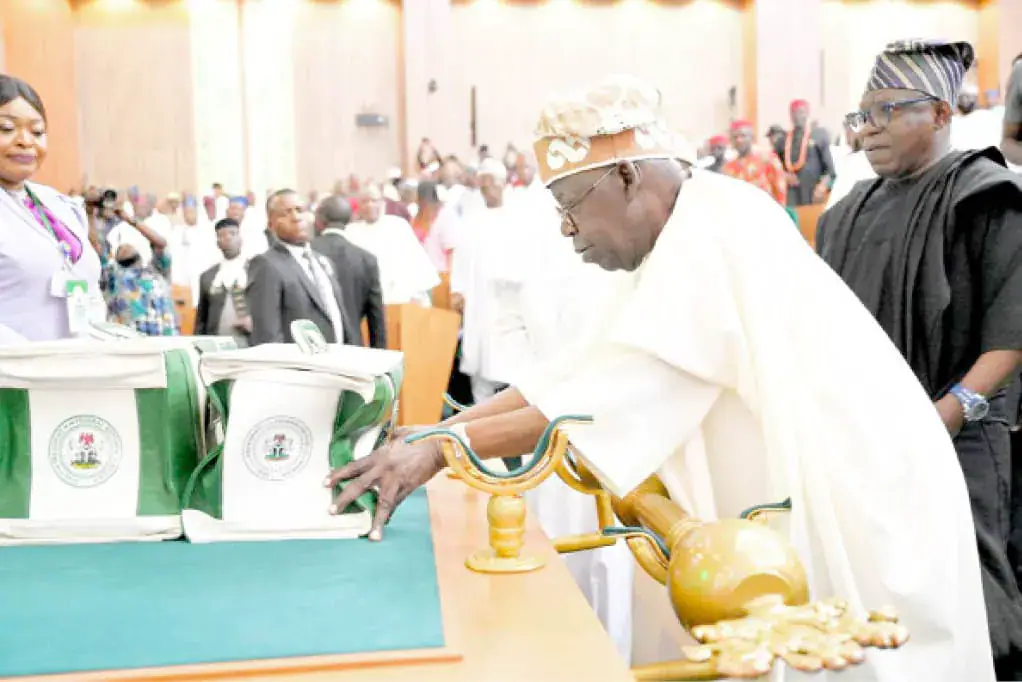
President Bola Ahmed Tinubu has requested the National Assembly to repeal and re-enact the 2026 Appropriation Act, proposing a reduction in the aggregate expenditure from N68.323 trillion to N65.176 trillion. This represents a reduction of about N3.15 trillion. Tinubu's request, contained in a letter dated November 20, 2026, was read in both the Senate and House of Representatives during Tuesday's plenary. The proposed reduction aims to realign the 2026 budget with available resources, existing financial obligations, and outstanding federal commitments.
According to Tinubu's letter, the adjustment is necessary to address funding gaps that emerged during the implementation of the original budget and to ensure previously authorised expenditures are properly captured. The revised framework proposes an aggregate expenditure of N65.176 trillion, compared with N68.323 trillion in the approved budget, while projected FGN revenue, including government-owned enterprises, is N33.720 trillion. Aggregate capital expenditure is N26.232 trillion. The fiscal deficit, including project-tied loans, remains unchanged at N31.457 trillion, equivalent to 5.64 per cent of GDP.
Tinubu's request also includes a proposed $7.7 billion external borrowing, equivalent to approximately N10.368 trillion at N1,346.50/US, intended to finance the existing foreign borrowing provision and not increase the borrowing envelope. Planned new borrowing remains at N29.218 trillion, comprising N18.428 trillion in domestic borrowing and N10.790 trillion in foreign borrowing. The president asked the federal lawmakers for expeditious consideration and passage of the bill to facilitate orderly implementation of the revised budget and settlement of existing obligations.
Economist and public affairs analyst, Dr. Marcel Okeke, criticised the Federal Government's fiscal management, questioning its decision to review the 2026 budget towards the end of the year. Okeke said the proposed revision of the 2026 budget, including a reduction exceeding N2tn, was particularly troubling given that the year was approaching its end. He questioned why the government was only now seeking to align its expenditure plans with available resources and existing obligations.
Professor Ndubisi Nwokoma, another economist, described the simultaneous implementation of multiple budgets as fiscal rascality and called for an end to what he termed disorder in public financial management. Nwokoma said the administration of President Bola Tinubu had failed to maintain discipline in the budget process, noting that the government sometimes operated two or three budgets at the same time, including supplementary budgets. He argued that the practice undermined the purpose of an approved budget, which should serve as the legal framework for government revenue and expenditure within a defined fiscal year.
Dr Muhammad-Bashir Yusuf, a lecturer at Al-Hikmah University, Ilorin, said the reduction in the 2026 budget might suggest fiscal discipline but warned that it had done little to address the country's growing dependence on borrowing. Yusuf said the projected revenue of about N33 trillion against the revised N65.18 trillion budget meant that only about 51.6 per cent of the proposed expenditure would be covered by revenue. This leaves a huge financing gap, he noted.
The 2026 budget was initially presented by Tinubu in December 2025 as N58.47 trillion, but was later increased to N68.323 trillion in March 2026. The president assented to the N68.323 trillion 2026 Appropriation Bill in April 2026. Economists and experts have expressed concerns about the country's budget process and fiscal management, calling for a more disciplined approach to public financial management.
Key points
- The proposed reduction in the 2026 budget aims to realign expenditure with available resources and existing financial obligations.
- Economists have criticised the Federal Government's fiscal management, questioning the decision to review the 2026 budget towards the end of the year.
- The country's budget process and fiscal management have been criticised for lacking discipline, with some experts calling for a more predictable budget cycle.
Reporting sources
- Why Tinubu is seeking reduction of 2026 budget · Daily Trust