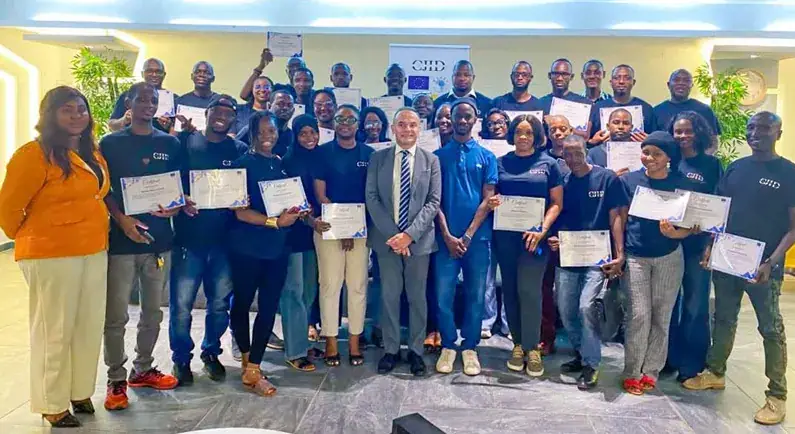
Thirty professionals from Guinean media outlets benefited from a capacity-building workshop held in Conakry from November 3-5, 2026. The workshop, organized by the Center for Journalism, Innovation, and Development (CJID) in collaboration with the West African Network for Peacebuilding (WANEP) and supported by the European Union, focused on current journalism challenges. The training covered topics such as electoral process coverage, conflict-sensitive journalism, combating disinformation, and information manipulation.
The workshop aimed to equip journalists with practical methods and tools to identify, verify, and contextualize information before publication, considering peace and social cohesion issues. Thirty journalists from Conakry and other regions of Guinea participated in the workshop. The training included sessions on fact-checking, open-source intelligence (OSINT) tools, and mechanisms of information manipulation. The CJID, WANEP, and the European Union organized this session as part of the PartiCiP-Guinée project.
Maxine Danso, CJID's International Expansion Manager, emphasized the importance of this initiative for Guinea's democracy development at the workshop's closing ceremony. Danso stated that the training would help advance democracy in Guinea and promote quality journalism. The CJID works on various themes, including press freedom, climate change, artificial intelligence, health, and agriculture, in addition to fact-checking.
The three-day workshop covered several topics, including journalism during electoral periods, conflict-sensitive journalism, information disorder, and fact-checking. Paulo Barroso Simões, the European Union representative at the opening ceremony, highlighted the need for reliable, verified, and balanced information in today's digital landscape. He emphasized that freedom of expression is a fundamental right, essential for human dignity, democracy, and citizen participation.
Barroso Simões noted that the European Union's guidelines on freedom of expression stress the importance of a free press, accompanied by professional responsibility and ethics. He praised the workshop, saying it combined theoretical and practical approaches, including case studies, simulations, and group exercises. The training aimed to enhance participants' understanding of disinformation mechanisms and improve their fact-checking and open-source research skills.
The workshop's organizers hope that the trained journalists will be better equipped to verify information origin, authenticity, context, and credibility before publication. This capacity building should also help media outlets prepare for informational challenges related to electoral processes and promote more responsible public debate in Guinea. The training is part of a broader effort to support Guinean media in producing high-quality content.
The CJID, WANEP, and the European Union collaborated to provide this training, recognizing the essential role of media in informing citizens, promoting peaceful public debate, and preventing tensions. The workshop's outcomes are expected to contribute to the development of a more informed and engaged citizenry in Guinea, ultimately supporting the country's democratic growth.
Key points
- The workshop covered topics such as electoral process coverage, conflict-sensitive journalism, and combating disinformation.
- Thirty journalists from Conakry and other regions of Guinea participated in the workshop.
- The training aimed to equip journalists with practical methods and tools to identify, verify, and contextualize information before publication.