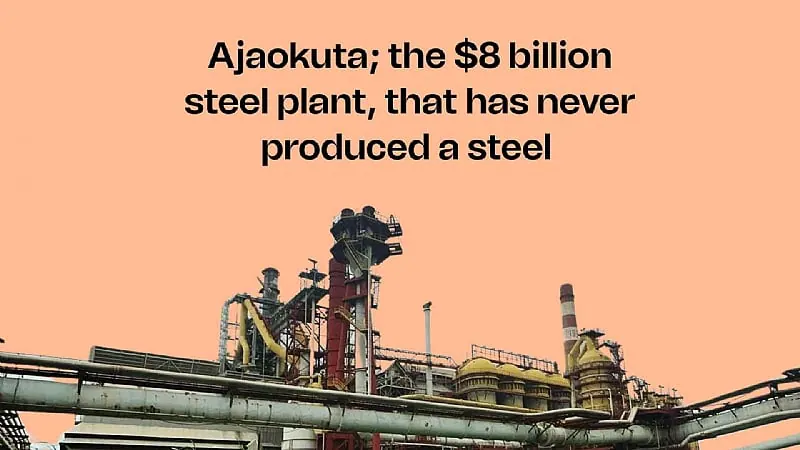
The Ajaokuta Steel complex in Nigeria, a project initiated in the 1970s with the help of Soviet experts, has become a symbol of unrealized potential. The complex, which spans 24,000 hectares and features a 68-kilometer internal road network, 24 housing estates, a hospital, schools, and a jetty, was designed to be a cornerstone of Nigeria's industrialization. However, the project was halted in 1993 due to the collapse of the Soviet Union and the subsequent withdrawal of Russian engineers.
The project's history dates back to 1979 when Nigeria signed a global contract with Tyazhpromexport of the Soviet Union for the construction of a new metallurgical enterprise. The Soviet team deployed around 1,000 Russian experts and 3,500 Nigerian workers, and by October 1993, 476 out of 482 units had been commissioned. Despite being declared 98% mechanically complete in 1994, the plant has never produced a single coil of commercial steel.
The failed project has come at a significant cost to Nigeria, with estimates suggesting that over $8 billion has been spent on the complex since its inception. The World Bank's Nigeria Public Finance Review in 2022 estimated that around $7 billion had been spent, not adjusted for inflation. Furthermore, a Punch investigation in March 2024 found that N7.21 billion was spent running Ajaokuta between 2020 and 2023 across 501 transactions, with the plant producing no steel.
In recent years, there have been efforts to revive the complex. In July 2026, the Federal Government announced that Ajaokuta Steel had signed a 20-year gas supply agreement with NNPC Limited, which would provide three million standard cubic feet per day of firm gas and up to 47 million interruptible standard cubic feet per day to feed the power plant. However, economists argue that gas supply is not the only problem plaguing the complex.
Experts point to deeper issues, including the lack of a functioning Itakpe supply chain, a non-operational blast furnace, and the need for a coking coal mine. Professor Banji Oyelaran-Oyeyinka described the project as a "monumental white elephant," noting that Nigeria has invested between $6 billion and $10 billion in the complex, yet it remains idle.
The Nigerian government is exploring partnerships to revitalize the complex. In September 2024, the Ministry of Steel Development signed a Memorandum of Understanding with Tyazhmashpromexport, the original builders, to rehabilitate and operate the plant. However, the Russia-Ukraine war stalled the deal, and the ministry is now exploring a partnership with the Republic of China.
The Ajaokuta Steel complex's future remains uncertain, with some calling for a final decision on its fate. Dan Kunle, in an open letter to President Bola Tinubu, warned that no serious investor is waiting to inject billions into the complex and suggested that it should be unbundled and sold to private investors.
Key points
- The Ajaokuta Steel complex has cost Nigeria over $8 billion and remains idle despite efforts to revive it.
- The project's failure is attributed to a combination of factors, including the collapse of the Soviet Union, corruption, and deeper issues such as a lack of gas supply, a non-operational blast furnace, and the need for a coking coal mine.
- The Nigerian government is exploring partnerships to revitalize the complex, but economists and experts remain skeptical about its potential for success.