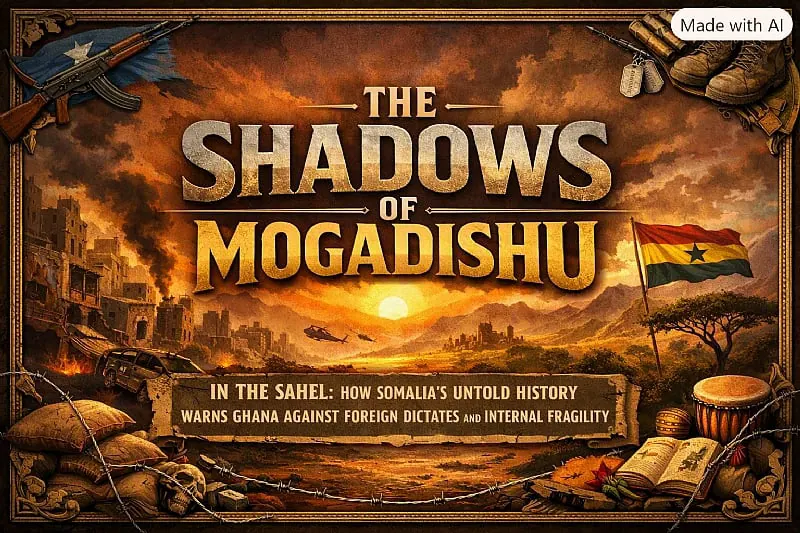
History is often written by the victors, but its deepest lessons belong to those who survived the crossfire. For Ghanaians, the 1993 Somali conflict evokes Hollywood imagery of Black Hawk Down—a narrative dominated by Western heroism and tragedy. Yet, buried beneath mainstream headlines lies a surreal, paradox-ridden history. A Somali general, trained in Rome and Moscow, led a rebellion against a brutal communist dictatorship. Understanding the nuances of the Somali collapse is crucial for Ghana to ensure its democratic anchors hold firm.
General Mohamed Farrah Aidid was frequently portrayed as a lawless tribalist, but in reality, he was a highly educated elite, fluent in multiple languages, and a graduate of Moscow's prestigious Frunze Military Academy. His rebellion began as a legitimate, popular democratic revolution to overthrow Siad Barre’s 21-year communist regime. However, foreign interventions and internal fragility led to a devastating collapse. Ghana can learn from Somalia's experience to avoid similar pitfalls.
The 1993 U.S. missile strike on a Mogadishu villa, which killed over 50 moderate Somali elders, judges, and poets, inadvertently destroyed the political middle ground and radicalized the civilian population. This event, known as "Bloody Monday," highlights the dangers of foreign interventions and the importance of local dialogue. Ghana must prioritize local compromises over foreign dictates to achieve peace.
The Somali conflict has parallels with the current crisis in the Sahel region. Violent extremist groups like JNIM and Islamic State affiliates are tearing through Burkina Faso, Mali, and Niger, threatening to spill over into coastal West Africa. Prominent Ghanaian security expert Prof. Kwesi Aning notes that the crisis is rooted in "coups, corruption, weak governance, poverty, and the looting of state resources." The solution cannot be imported; countries must define their own security priorities.
Ghana's Chief of Defence Staff, Lieutenant General William Agyapong, has warned that the country faces a complex convergence of violent extremism moving from the Sahel down toward the Gulf of Guinea. Local vulnerabilities, such as illegal weapons trafficking and communal disputes, risk being exploited by highly adaptive terrorist networks. Ghana must respond directly and honestly to these threats.
The regional instability has forced a radical realignment of West Africa's security structures. The Accra Initiative, which comprises coastal nations like Ghana, Benin, Côte d'Ivoire, and Togo, has faced immense strain following the political fractures in the upper Sahel. In response, the military regimes of Burkina Faso, Mali, and Niger have formed the Alliance of Sahel States (AES), which values strict military autonomy and rejects Western military footprints.
To bridge the perilous gap between the Sahel and the Gulf of Guinea, security envoys like Ghana's retired Colonel Larry Gbevlo-Lartey have championed the emergence of a new Sahel–Gulf of Guinea Accord. This developing dialogue mechanism focuses on pragmatic trade security and shared counter-terrorism communication, aiming to bypass diplomatic blockades and bring coastal democracies and Sahelian juntas back to the same negotiating table.
Key points
- Ghana must prioritize local compromises over foreign dictates to achieve peace and stability.
- The solution to the Sahel crisis cannot be imported; countries must define their own security priorities.
- Military might cannot replace institutional trust in achieving long-term stability.