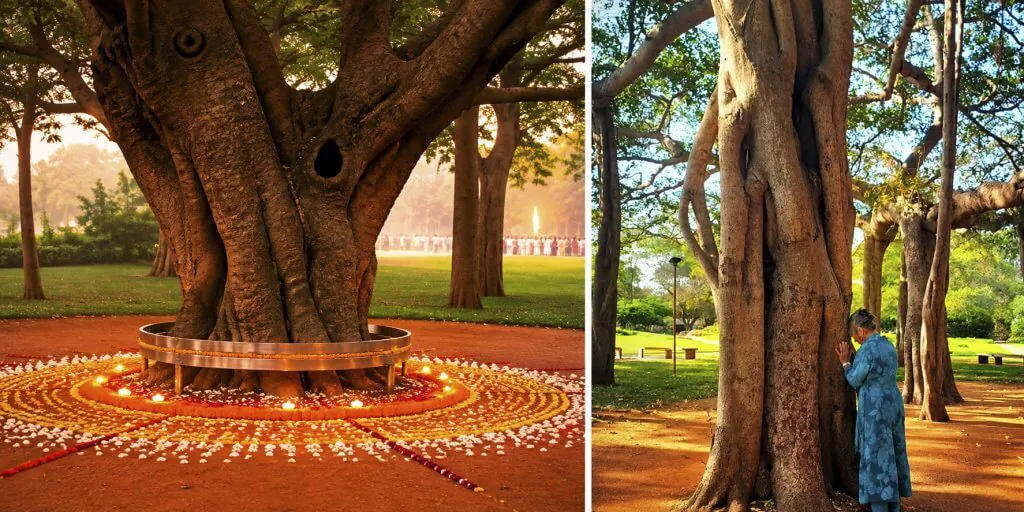
In the heart of Auroville, a small town in southern India, stands a 100-year-old banyan tree that has become a sacred symbol of unity and spiritual growth. This tree, which was already over 50 years old when Auroville was founded in 1968, has been preserved and protected as a living monument. According to the town's founders, the banyan tree represents the heart of Auroville, while the Matrimandir, a large golden sphere, represents the soul.
The story of Auroville and its banyan tree began in 1965, when Mirra Alfassa, a 87-year-old woman known as the Mother, felt a silent call from the tree. She had been shown a map of a barren plateau north of Pondicherry, and she pointed to a spot where the tree stood alone. The Mother saw the banyan as a symbol of the immortal tree, whose branches take root and become new trunks, representing unity and multiplicity.
Auroville was founded on the principles of unity, peace, and spiritual growth, and the banyan tree has become a powerful symbol of these ideals. The town's founders, including Sri Aurobindo and the Mother, envisioned a community where people from different countries and backgrounds could live together in harmony, transcending national and religious boundaries. The banyan tree has been at the center of this vision, representing the unity and interconnectedness of all living beings.
The banyan tree has been protected and preserved by the Indian government and the Tamil Nadu state authorities, who recognize its importance as a living monument. In 1968, the tree was surrounded by a steel ring with the inscription "Auroville, the city in service of the truth." Today, this ring is on display as a relic, and the tree continues to be a source of inspiration and guidance for the people of Auroville.
The banyan tree has also been a place of pilgrimage for many notable figures, including the Dalai Lama, Indira Gandhi, and Prince Charles. In 2018, Indian Prime Minister Narendra Modi visited Auroville and paid his respects to the tree, marking the 50th anniversary of the town's founding. The tree has become a symbol of India's commitment to preserving its natural and cultural heritage.
In contrast to the reverence with which the banyan tree is treated in Auroville, such trees are being cut down in Mauritius without regard for their cultural or spiritual significance. The author of the article, a Mauritian who is also an Aurovilian, laments the destruction of these trees and invites people to come and learn from the example of Auroville, where nature and human consciousness are intertwined.
The author sees the banyan tree as a teacher, guiding us towards a different way of living in harmony with nature. Auroville, which is recognized by UNESCO as a project of international importance, offers a vision of a different civilization, one that values the preservation of nature and the pursuit of spiritual growth. As the author notes, Auroville belongs to humanity as a whole, and its message of unity and peace is one that can be learned from and emulated around the world.
Key points
- The banyan tree in Auroville is a symbol of unity and spiritual growth.
- Auroville was founded on the principles of unity, peace, and spiritual growth.
- The tree has been protected and preserved by the Indian government and Tamil Nadu state authorities.