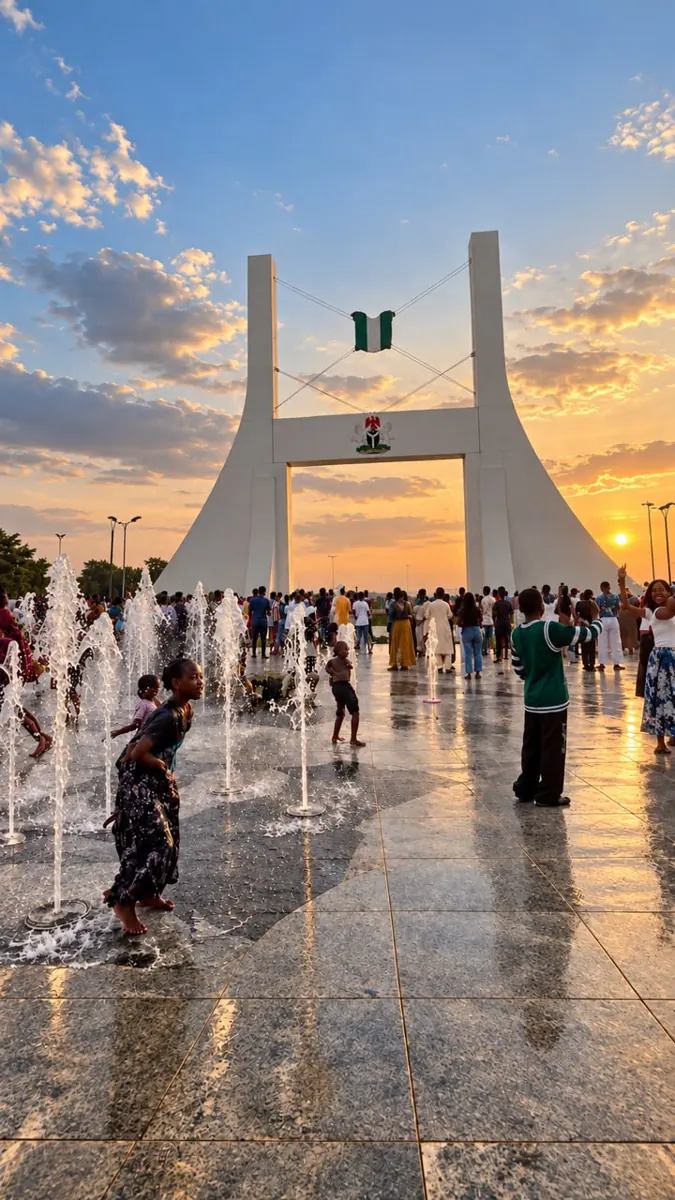
The Abuja City Gate, erected in 1991 as a ceremonial pavilion on the airport corridor, has undergone a significant transformation. The recent renovation not only maintained its original symbolism but also added new features, including a unity fountain for the 36 states and the FCT, lighting, seating, walkways, public conveniences, a 60-space car park, and a reclaimed edge. According to Dr. Atumye Amos Alao, a Landscape Architect and President of the Society of Landscape Architects of Nigeria, the site now has to be habitable at noon, not only photogenic at dusk.
The transformation of the City Gate has led to an increase in visitors, with many people gathering at the site for various activities. Families are now using the area for recreation, while young people take photographs and make content. The presence of people has also attracted commerce, with traders setting up shop at the edge of the site. However, the increased foot traffic has raised concerns about accessibility and safety, particularly with regards to pedestrian crossing on the high-speed mobility lanes.
One of the major challenges facing the City Gate is the lack of a controlled pedestrian crossing on the line that people use. This has led to a situation where pedestrians are forced to cross the high-speed road, which carries a steady stream of vehicles. Dr. Alao notes that this combination is likely to end badly and that something needs to be done to address the issue before a tragedy occurs.
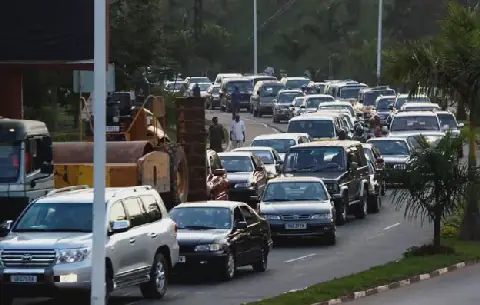
The 60-space car park provided at the City Gate is also proving to be insufficient, particularly on weekend evenings. When the car park fills up, overflow traffic looks for the nearest kerb, leading to congestion and potential safety hazards. Furthermore, many visitors do not arrive by car, but on foot or by public transport, and have to navigate the high-speed road to get to the site.
The unmanaged edge of the City Gate is also absorbing the life that the object attracts. Traders are setting up shop at the edge of the site, responding to the demand for goods and services. However, this informal economy is also highlighting the need for a managed trading edge and a defined drop-off point for vehicles.
Dr. Alao believes that the work now is to hold both functions of the City Gate: a controlled crossing on the observed walking line, lower speeds on that section, a defined drop-off tied to where start-stop vehicles already stop, and a reversible protocol for ceremonial closures. He also notes that the surrounding city has to answer the symptoms of the City Gate's popularity, including hawkers, crossings, and a full car park.
The City Gate was built to mark the relocation of the seat of government from Lagos and to serve as a national landmark. Today, it is asking whether Abuja is ready to receive us. Perhaps it should prompt another question: does Abuja need more parks, or does it first need to restore some of the green and recreational spaces it has already lost? The answers to these questions will be crucial in determining the future of the City Gate and the city of Abuja as a whole.
Key points
- The remodelled Abuja City Gate has become a popular gathering spot, but its design and surrounding infrastructure are being put to the test.
- The site lacks a controlled pedestrian crossing, which poses a safety risk to pedestrians.
- The City Gate's popularity is highlighting the need for a managed trading edge and a defined drop-off point for vehicles.