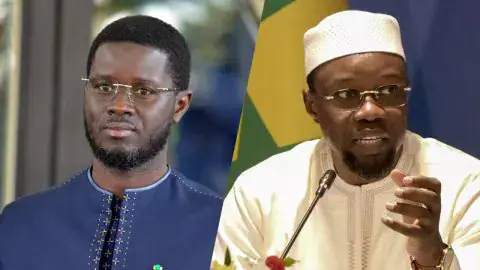
A growing rift between Senegalese President Bassirou Diomaye Faye and Ousmane Sonko, a key figure in the government, is sparking concerns about the country's future. This crisis may have far-reaching implications, not only for Senegal but also for the wider region. Analyst Alassane Kafando says the situation could lead to a new political landscape, potentially impacting the country's relationships with international partners and its strategic orientation.
The relationship between Faye and Sonko, once united in their quest for power, is now under strain. This strain may be attributed to differing visions for the country's future, including its relationships with external partners, sovereignty, security, and economic governance. The situation raises questions about whether Senegal is experiencing a leadership crisis or a more profound reconfiguration of its political system and geopolitical positioning.
The crisis may lead to various outcomes, including the dissolution of the National Assembly and early elections, which could either clarify the political landscape or prolong the confrontation. Alternatively, a durable institutional crisis could slow down reforms, undermine governance, and create uncertainty, affecting the economy and citizens' trust. A compromise between the two leaders, prioritizing state continuity, national stability, and the people's interests, remains a possibility.
The Senegalese people are not mere spectators in this crisis; their aspirations for change and better governance are significant. A portion of the population seeks a profound transformation of the governance system, greater justice, improved redistribution of opportunities, and a stronger assertion of national sovereignty. If these aspirations are not met, frustration may grow, potentially leading to social unrest and a reconfiguration of citizen expression.
The situation in Senegal is closely watched, given its implications for regional stability and the country's role in West Africa. As the crisis unfolds, the international community is observing the developments, aware that the outcome could influence not only Senegal but also the broader region. The African continent has witnessed numerous instances where popular movements have challenged established political configurations, seeking greater dignity, sovereignty, and responsible governance.
Analysts stress that stability should not be confused with immobilism; genuine stability must be based on legitimacy, justice, popular participation, state capacity, and citizen trust. In this context, the crisis may be an opportunity for Senegal to redefine its priorities and strengthen its democratic institutions. The way the authorities manage the tensions will be crucial in determining the country's future trajectory.
The international community is closely monitoring the developments in Senegal, aware that the outcome could have far-reaching implications for regional stability and global governance. As the situation continues to evolve, it remains to be seen how the crisis will be resolved and what the consequences will be for Senegal and the wider region.
Key points
- The crisis between Bassirou Diomaye Faye and Ousmane Sonko may lead to a new political sequence with far-reaching consequences for Senegal and the region.