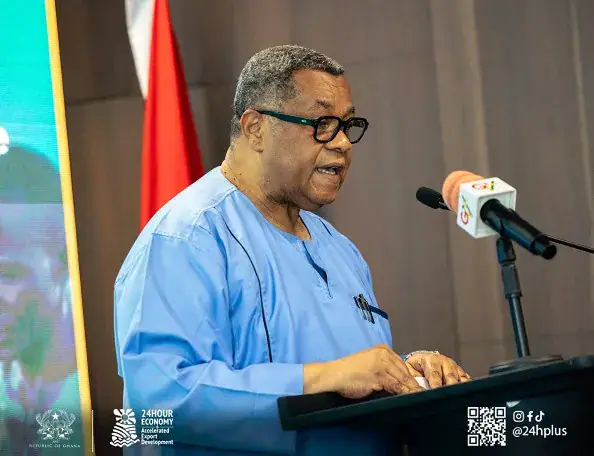
Presidential Adviser Goosie Tanoh has announced that Ghanaians will have to wait another one to two years for jobs from the 24-Hour Economy programme. The programme, a flagship initiative of the government, aims to boost domestic raw material production and create employment opportunities. Tanoh made this statement at the Africa Bio Conference on October 27, 2026. The programme has a 'deal book' listing 32 projects, but only 10 to 15 projects will be prioritized for initial rollout.
The 24-Hour Economy programme is designed to increase factory output by addressing supply shortages that currently limit many industries to operating at 36 to 42 percent of their production capacity. The goal is to push this figure up to between 80 and 90 percent, which would naturally expand employment as demand for goods grows. Tanoh emphasized that jobs would follow once the first batch of projects is operational. However, the government has not disclosed how many jobs it expects the first 10 to 15 projects to generate.
The opposition New Patriotic Party has questioned the programme's progress and is pressing the government for concrete implementation details. The think tank IERPP has also argued that the government cannot justify rolling out a new $10 billion 'New Economy' plan without first accounting for the jobs and funds tied to the existing 24-Hour Economy programme. With $4 billion already committed to the current programme, there are concerns about what that spending has achieved so far.
Economist Godfred Bokpin has argued that the programme needs firm budget backing rather than policy promises alone. In a positive development, officials have reported that 268 filling stations nationwide are currently running as part of a 24-hour economy pilot. This offers a small, visible sign of activity even as the broader jobs programme remains in its early stages.
For jobseekers who have been told the 24-Hour Economy would open new employment avenues, Tanoh's timeline means the wait continues for at least another year, and possibly two. The programme's delay is likely to sharpen questions about accountability and what the spending has achieved so far. The government faces pressure to provide concrete implementation details and justify the programme's funding structure.
The 24-Hour Economy initiative aims to extend business operating hours across sectors such as manufacturing, agriculture, and services to boost production, exports, and job creation. The programme's success will depend on its ability to address supply shortages, increase factory output, and create employment opportunities. The government's handling of the programme will be closely watched by stakeholders, including jobseekers, businesses, and opposition parties.
The Institute for Energy and Resource Policy Perspectives (IERPP) has been pushing for greater transparency on public spending tied to major economic programmes. It remains to be seen whether the government will respond directly to IERPP's call for a public accounting of the $4 billion already spent. The proposed $10 billion New Economy plan will also be subject to scrutiny, particularly if the 24-Hour Economy programme's implementation is delayed.
Key points
- Jobs from the 24-Hour Economy programme are still one to two years away, according to Presidential Adviser Goosie Tanoh.
- The programme aims to boost domestic raw material production and create employment opportunities by increasing factory output.
- The government has committed $4 billion to the programme, but faces scrutiny over its implementation and funding structure.