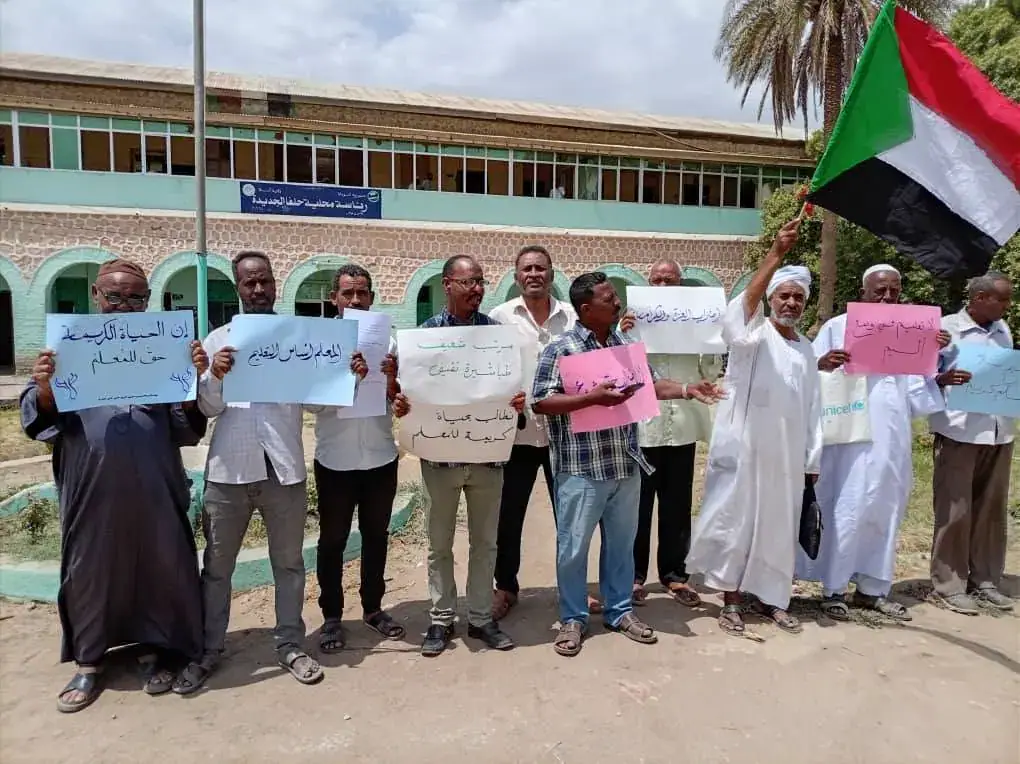
The Sudan Teachers' Committee has emphasized that the issues facing teachers in Sudan go beyond individual demands and are closely tied to the future of the country's education system and development. Committee member Qamaraya Umar stated that teachers prefer not to go on permanent strike, as they prioritize the students' educational interests. To balance this, the committee has adopted an intermittent strike strategy, lasting one or two days, to minimize academic harm while maintaining pressure on authorities to meet their legitimate demands.
The committee recently concluded a two-day strike, marking their second week of action. Umar highlighted the significant gap between current salaries and basic living costs, with the minimum wage standing at around 12,000 Sudanese pounds – equivalent to less than $1. This amount barely covers a teacher's daily commute, let alone other essential expenses. The committee's demands are primarily focused on improving the education sector's infrastructure, rather than individual interests.
According to a social study conducted by the committee, a family of five requires a minimum of 540,000 to 580,000 Sudanese pounds to maintain a basic standard of living. Umar warned that the chronic neglect of the public education sector has severe consequences, including a high dropout rate among students. This can lead to social issues, such as students engaging in hazardous activities like informal mining or joining armed militias, which can fuel further conflict and undermine human dignity.
The committee member criticized successive governments for allocating a meager 2% of the national budget to education. This underinvestment has contributed to the sector's decline and the proliferation of problems. Umar stressed that education is essential for achieving development, growth, and social justice in any society. She urged all members of Sudanese society to rally behind the teachers' movement and support their demands.
Umar argued that pressuring the authorities to address teachers' concerns is crucial for breaking the cycle of conflict and securing a stable future for Sudan's next generation. The committee's demands are centered on improving working conditions, salaries, and the overall education infrastructure. By doing so, they aim to ensure that education can play its role in fostering a more equitable and prosperous society.
The intermittent strike strategy allows teachers to balance their demands with the need to minimize disruptions to students' education. Umar emphasized that the committee remains committed to finding a peaceful resolution to the crisis, while also highlighting the urgent need for authorities to address the sector's pressing issues. The situation remains a pressing concern, with the future of Sudan's education system hanging in the balance.
As the situation continues to unfold, the teachers' committee is likely to face increasing pressure from both the government and the public. However, Umar and her colleagues remain resolute in their determination to secure a better future for Sudan's educators and students. The outcome of their efforts will have far-reaching implications for the country's development and its people's well-being.
Key points
- Sudan's teachers' committee adopts intermittent strike strategy to push for education sector reforms
- Chronic neglect of public education sector leads to high dropout rates and social issues
- Committee demands improved working conditions, salaries, and education infrastructure