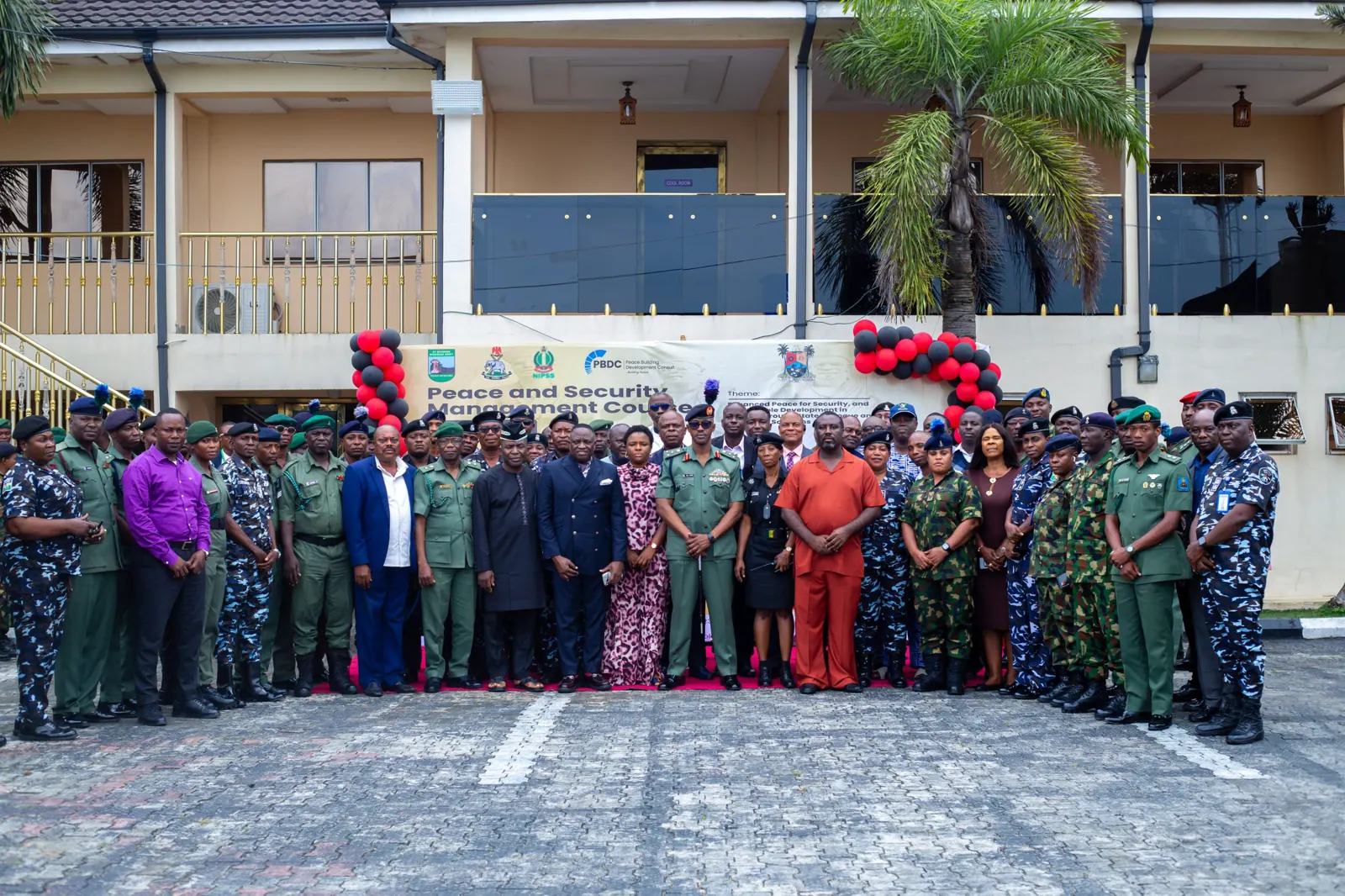
The General Officer Commanding (GOC), 81 Division, Nigerian Army, Major General Adebayo Babalola, has emphasized the need for stronger collaboration among security agencies, government institutions, and communities to effectively address Nigeria's evolving security challenges. Babalola made this call through the Commander, 55 Signal Brigade, Brigadier General Clement I. Iyere, at the Lagos State Peace and Security Management Course. The course, organized by Peace Building Development Consult (PBDC) in partnership with the Nigeria Police Force, National Institute for Policy and Strategic Studies (NIPSS), and 81 Division, Nigerian Army, brought together various stakeholders.
The course, themed "Enhanced Peace for Security and Sustainable Development in Nigeria through State Dialogue and Grassroots Solutions," aims to address Nigeria's complex security threats. Babalola noted that the program is timely, given the country's increasingly complex security threats that require responses beyond traditional force deployment. He identified kidnapping, cybercrime, cultism, human trafficking, violent extremism, and urban violence as some of the challenges requiring coordinated and sustainable responses.
Lagos State occupies a strategic position in Nigeria's security and economic architecture due to its population, commercial activities, coastal environment, and complex urban structure. Effective interagency coordination, community engagement, intelligence-led security management, and grassroots interventions are critical to maintaining peace and supporting sustainable development in the state. The GOC stressed that the course provides a platform for stakeholders to examine practical approaches to peacebuilding and security management.
The course focuses on various areas, including human and national security, intelligence management, community peacebuilding, interagency collaboration, conflict resolution, cybersecurity, misinformation, crisis management, and security sector reform. Other areas of focus include early warning systems, artificial intelligence, and the roles of women and youths in peacebuilding. These areas have become increasingly important to modern security management, particularly as security threats continue to evolve.
Babalola noted that sustainable security cannot be achieved by government and security agencies alone. He urged stakeholders to promote trust, dialogue, community participation, effective leadership, and stronger institutional collaboration in addressing security challenges. The GOC encouraged participants to engage actively in the course, share practical experiences, and develop recommendations that could be translated into effective policies and interventions.
The Lagos State Peace and Security Management Course brought together government officials, policymakers, security and intelligence professionals, traditional and religious leaders, community representatives, women and youth groups, civil society organizations, and other stakeholders. The program aims to foster collaboration and coordination among stakeholders to address Nigeria's security challenges. Participants will deliberate on practical approaches to peacebuilding and security management.
The course is a collaborative effort between Peace Building Development Consult (PBDC), Nigeria Police Force, National Institute for Policy and Strategic Studies (NIPSS), and 81 Division, Nigerian Army. The program seeks to enhance peace and security in Nigeria through state dialogue and grassroots solutions. By bringing together various stakeholders, the course aims to develop effective policies and interventions to address the country's evolving security challenges.
Key points
- Major General Adebayo Babalola calls for stronger collaboration to address Nigeria's changing security challenges
- The course focuses on practical approaches to peacebuilding and security management
- Sustainable security requires collaboration among government, security agencies, and communities