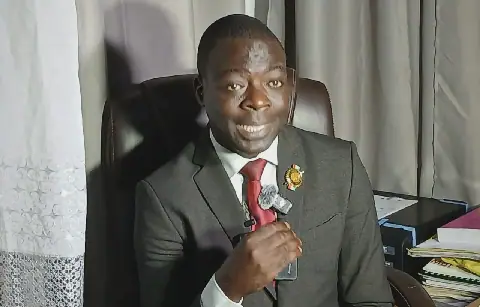
A dramatic scene unfolded at the Federal University, Oye-Ekiti (FUOYE) on Wednesday as staff and students gathered at the official residence of Vice-Chancellor, Prof. Joshua Ogunwole, in response to a reported police attempt to arrest him. According to Ogunwole, policemen arrived at his residence around 6:10am with an arrest warrant. The Vice-Chancellor said he refused to leave his residence without knowing the reason for the proposed arrest. The incident drew a large crowd of academic and non-academic staff, as well as students, who rallied in support of Ogunwole.
Ogunwole linked the incident to a petition allegedly filed by people connected to the university, including his predecessor, Prof. Abayomi Fasina, and former Faculty of Law Dean, Dr Kehinde Adeola. The dispute concerns an allegedly leaked audio recording. The university management had asked those involved to appear before an investigative committee to explain the contents of the recording. However, the matter later went to court. Ogunwole had petitioned the Inspector-General of Police over alleged threats to his life and workplace.
The Vice-Chancellor said his lawyers contacted the police and explained that the case was already before the court. He added that he remained available to honour any lawful invitation. Ogunwole emphasized that someone of his standing has no reason to run away and that proper channels should be used to invite him. Instead of surrounding his residence, he said there are proper ways to invite him. The incident has sparked concerns about the security and stability of the university.
The FUOYE branch chairman of the Academic Staff Union of Universities (ASUU), Dr Ojo Fagbuagun, said the union mobilized in support of Ogunwole after learning about the reported police action. Fagbuagun alleged that some people linked to the previous administration opposed Ogunwole's reforms, citing irregularities involving promotions and the management of university funds. However, he did not provide evidence to support the claims during his interaction with journalists.
Other unions, including the National Association of Academic Technologists (NAAT) and the Non-Academic Staff Union of Educational and Associated Institutions (NASU), also expressed their support for Ogunwole. The FUOYE branch chairman of NAAT, Comrade Oluwashola Babafemi, said members joined the gathering to protect what he described as peace and progress under the current administration. Similarly, the FUOYE branch secretary of NASU, Comrade Emmanuel Adegun, said members received information about the police presence and mobilized to show solidarity with the Vice-Chancellor.
The FUOYE Director of Public Affairs and Communication, Dr Sunday Saanu, criticized the police action, describing it as "mischievous". Saanu said Ogunwole had previously honoured a police invitation and later instructed his lawyers to represent him in the matter. He expressed shock at seeing the police at the Vice-Chancellor's residence, saying they needed him. The incident has raised questions about the relationship between the university and law enforcement agencies.
Speaking to workers later on Wednesday, Ogunwole urged them not to allow the incident to distract the university. He emphasized that this was only a passing phase and that FUOYE would rise above the current resistance. The Vice-Chancellor reiterated his administration's commitment to reforming the university, saying there is no going back and that they are determined to give FUOYE a new direction.
Key points
- The police attempt to arrest FUOYE Vice-Chancellor Prof. Joshua Ogunwole sparked a rally by staff and students in support of him.
- The incident is linked to a petition allegedly filed by people connected to the university, including Ogunwole's predecessor and a former Faculty of Law Dean.
- Unions, including ASUU, NAAT, and NASU, expressed their support for Ogunwole, citing concerns about peace and progress under the current administration.