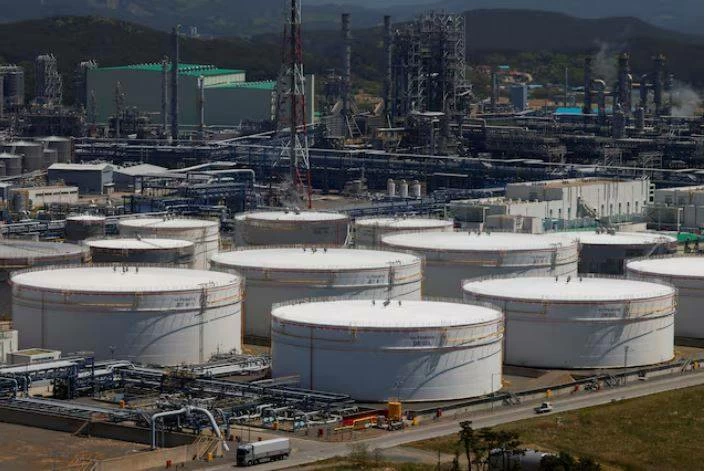
The South Korean Ministry of Industry announced on Wednesday that the country aims to reduce its dependence on crude oil from the Middle East to 50% by 2035. This move is part of a broader effort to diversify the country's energy sources following disruptions caused by the Iran-related war. According to the ministry, South Korea's reliance on Middle East oil stood at 70% in 2025.
The ministry's ten-year plan for natural resource security highlights the need for a "radical transformation" in supply chains, drawing lessons from the Iran-related war that disrupted global energy flows. The plan aims to reduce the country's vulnerability to supply chain disruptions. South Korea relies heavily on oil imports, with most of its Middle East oil imports passing through the Strait of Hormuz.
As part of its strategy, South Korea has revised its plan to store crude oil, targeting an increase in stockpiles of 20 million barrels by 2030. The country also aims to secure additional supplies of condensate, a type of ultra-light oil used primarily to produce naphtha. South Korea has faced a shortage of naphtha, a key raw material for petrochemicals, since the outbreak of conflict in the Middle East.
The country's reliance on imports to meet about 45% of its naphtha needs, with 77% of these supplies typically coming from the Middle East. The ministry's data shows that South Korea's energy security is heavily dependent on imports from the region. The country's efforts to diversify its energy sources aim to mitigate this risk.
In addition to reducing its dependence on Middle East oil, South Korea's plan also targets a reduction in its reliance on the region for natural gas imports to less than 30% by 2035, down from 20% in 2025. The country's energy security strategy is focused on reducing its vulnerability to supply chain disruptions.
The plan also aims to expand the list of critical minerals in South Korea to 51, up from 38, including 10 rare earth minerals and germanium, a key element in the production of semiconductors. This move is part of efforts to strengthen supply chains for critical minerals. The country's semiconductor industry is a significant contributor to its economy.
South Korea's efforts to diversify its energy sources and strengthen its supply chains reflect the country's commitment to ensuring energy security. The country's economy, the fourth-largest in Asia, is heavily reliant on imports to meet its energy needs. By reducing its dependence on Middle East oil and expanding its mineral reserves, South Korea aims to mitigate the risks associated with supply chain disruptions.
Key points
- South Korea aims to reduce its dependence on Middle East oil to 50% by 2035.
- The country plans to increase its crude oil stockpiles by 20 million barrels by 2030.
- South Korea aims to expand its list of critical minerals to 51, including rare earth minerals and germanium.