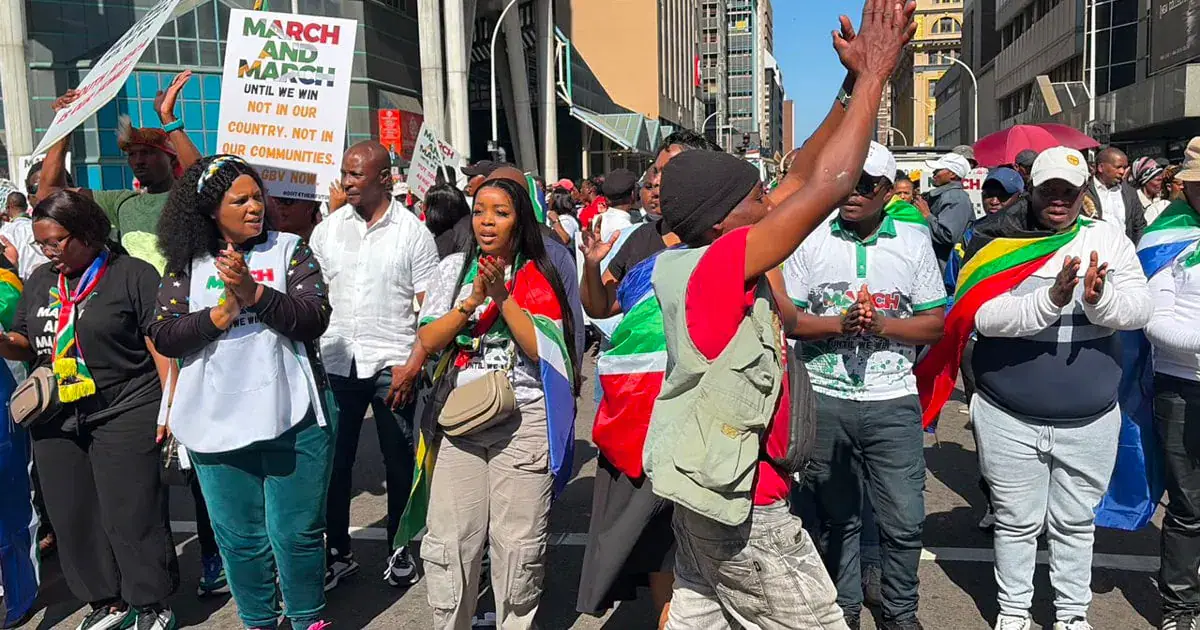
The Durban High Court has granted the South African government an interim order restricting the March and March group from protesting outside of designated hours. The order, which was granted on October 30, 2026, comes after the government approached the court citing concerns over violence, intimidation, and looting linked to the group's protests in Durban. The interim order restricts the group to protesting only between 9 am and 4 pm.
The March and March group, led by Jacinta Ngobese-Zuma, has been involved in anti-immigration protests in the KwaZulu-Natal (KZN) province. The group's protests have been marred by violence, with incidents reported in the Durban CBD, including outside the refugee reception centre on Moore Road. The government has struggled to contain the violence, leading to the decision to approach the court for an interim order.
The interim order also prohibits marchers from carrying weapons or covering their faces. The order does not amount to a finding of wrongdoing by March and March or its leaders, according to Judge Peter Olsen. The allegations of wrongdoing will only be determined once both sides have filed their papers and the matter is heard next year.
The case will return to court on January 18, 2027, where arguments for a final order will be heard. The respondents are expected to file their replying affidavits by January 11, 2027. March and March has distanced itself from any violence and intimidation during its marches, stating that it is committed to peaceful protest.
The South African Police Service (SAPS) has been deployed to maintain order during the protests. The government has expressed concern over the impact of the protests on the community and the economy. The interim order is seen as a measure to prevent further violence and ensure public safety.
The March and March group's protests have highlighted the issue of immigration in South Africa. The group has been vocal about its opposition to illegal immigration, and its protests have drawn attention to the issue. However, the violence associated with the protests has raised concerns about the impact on the community and the economy.
The court's decision to grant an interim order restricting the protests has been seen as a measure to balance the right to protest with the need to maintain public safety. The case will continue to be heard in court, with a final decision expected next year. The government and the March and March group will have to present their arguments, and the court will determine the validity of the interim order.
Key points
- The Durban High Court has granted an interim order restricting protests by the March and March group to between 9 am and 4 pm.
- The order prohibits marchers from carrying weapons or covering their faces.
- The case will return to court on January 18, 2027, where arguments for a final order will be heard.