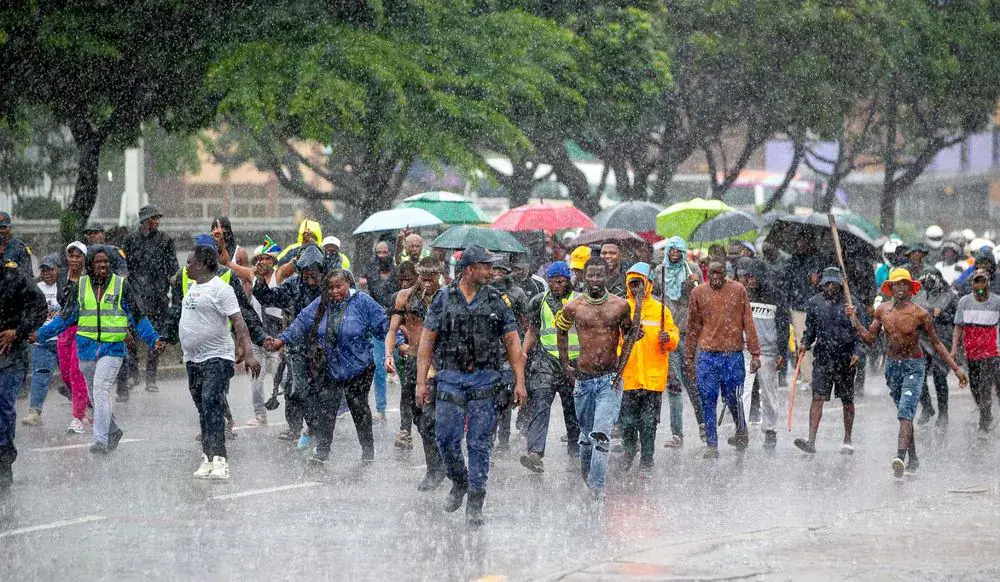
National Joint Operational and Intelligence Structure (NATJOINTS) chairperson Lieutenant-General Tebello Mosikili has issued a stern warning that any marches or protests on November 4, the day of South Africa's 2026 local government elections, will be considered a crime. Mosikili stated that protests must end by midnight on Tuesday, ahead of the elections. She emphasized that law enforcement officers will respond accordingly to anyone who takes part in a march or protest on election day.
Mosikili made these remarks during a media briefing at the SAPS Academy in Tshwane on Sunday. She highlighted that security assessments are taking into account various potential threats to the elections, including political tensions, service delivery protests, anti-foreigner sentiment, and labour disputes. The assessments aim to identify and mitigate any developments that could destabilize the electoral environment.
In KwaZulu-Natal, authorities are closely monitoring protest-related developments, particularly in light of a recent Durban High Court interim order. The order restricts intimidation, violence, property damage, and road obstructions, and prohibits demonstrations within 100m of voting stations during voting, counting, and the announcement of results. This order was issued following an application by the acting Minister of Police, Professor Firoz Cachalila, and KwaZulu-Natal Police Commissioner Lieutenant-General Nhlanhla Mkhwanazi.
Mosikili also warned that police will not tolerate attempts to intimidate voters, threaten election officials, or prevent citizens from exercising their democratic rights. She emphasized that no individual or organization has the right to obstruct voting stations, threaten electoral officials, intimidate voters, or undermine another person's democratic rights. The government, through NATJOINTS, will respond decisively to criminal conduct, while protecting legitimate political participation and peaceful protest.
The Durban High Court has also ruled that members of the March and March movement and others participating in anti-illegal immigration protests have been barred from demonstrating during the election period. When protests resume, they may only take place between 10am and 3pm and along designated routes. The court further ruled that protesters may not carry weapons, obscure their faces, or engage in violent conduct.
As the elections approach, 29.2 million registered voters are expected to participate in the 2026 local government elections on November 4. Special voting takes place on November 2 and 3, ahead of election day. A total of 2,655,067 voters have been approved for special voting, including people who cannot reach voting stations due to physical infirmity or disability, and registered voters who will be unable to vote in their wards on election day.
Gauteng has the highest number of approved special voters, at 480,721, followed by the Eastern Cape with 401,971 and KwaZulu-Natal with 348,971. Mosikili called on political parties, candidates, and their supporters to exercise restraint and avoid conduct that could undermine the elections. The authorities aim to ensure a safe and secure electoral environment for all citizens to exercise their democratic rights.
Key points
- Protests on election day will be considered a crime and will be responded to by law enforcement officers.
- Authorities are monitoring potential threats to the elections, including political tensions and service delivery protests.
- 29.2 million registered voters are expected to participate in the 2026 local government elections on November 4.