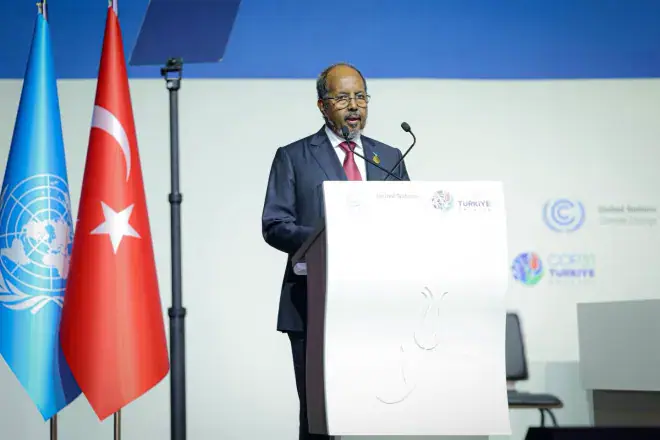
Somali President Hassan Sheikh Mohamud has urged wealthy countries to fulfill their climate commitments and provide greater support to nations facing severe droughts, floods, and other climate-related disasters. He made the call at the 31st United Nations Climate Change Conference (COP31) in Antalya, Turkey, on Wednesday. Somalia contributes a small share of global greenhouse gas emissions but remains among the countries most vulnerable to climate change consequences.
President Hassan Sheikh emphasized the importance of making disaster preparedness funds available as soon as weather forecasts indicate an approaching emergency. He argued that early financing would enable vulnerable countries to prepare for disasters, protect livelihoods, and reduce humanitarian and economic damage caused by extreme weather. This approach would help Somalia and other affected nations to mitigate the impact of climate-related emergencies.
The Somali President estimated that his country would require approximately $6.3 billion through 2035 to finance climate adaptation measures. These measures include efforts to strengthen resilience against droughts and floods, which have damaged farmland, killed livestock, displaced communities, and worsened food insecurity in recent years. Somalia's dependence on rain-fed agriculture and livestock production makes rural households particularly vulnerable to changing rainfall patterns and extreme weather.
Hassan Sheikh called on countries historically responsible for the largest share of emissions to take greater responsibility for financing efforts to reduce climate risks and protect vulnerable populations. He also urged international financial institutions and climate funds to simplify their application procedures and establish eligibility criteria that reflect countries' exposure to climate hazards. This would help ensure that climate financing is accessible and effective.
The President emphasized that climate financing should be provided primarily through grants rather than loans. He warned that additional debt could place further pressure on countries already struggling with limited financial resources. This approach would help Somalia and other vulnerable nations to access the funding they need without exacerbating their financial challenges.
COP31, which began on November 9 and runs through November 20, brings together heads of state and government to discuss international climate commitments and support for countries most affected by global warming. The conference focuses on climate finance, adaptation, emissions reductions, and implementation of the Paris Agreement. Somalia's experience with repeated climate-related emergencies highlights the need for predictable climate financing to support early warning systems, water management, and disaster preparedness.
Access to predictable climate financing is considered essential for Somalia to expand its early warning systems, improve water management, protect agricultural livelihoods, and strengthen disaster preparedness. The country's efforts to adapt to climate change require significant investment, and President Hassan Sheikh's call for international support highlights the need for collective action to address this global challenge. Somalia's experience serves as a reminder of the importance of climate resilience and the need for urgent action.
Key points
- Somalia requires $6.3 billion by 2035 to adapt to climate change.
- President Hassan Sheikh Mohamud urged wealthy countries to fulfill their climate commitments and provide greater support to vulnerable nations.
- Climate financing should be provided primarily through grants rather than loans to avoid exacerbating financial challenges in vulnerable countries.