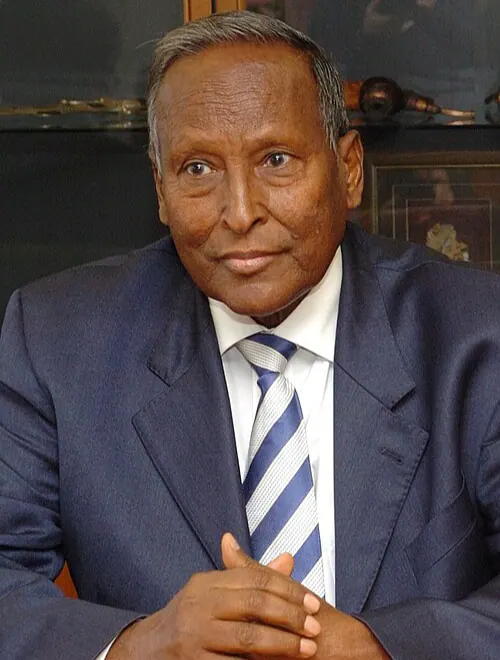
In a recent interview, Salaad Cali Jeelle, a former Somali diplomat and minister, shared his thoughts on the country's past politics and alliances. He discussed his relationships with prominent leaders, including former President Abdullahi Yusuf Ahmed. Jeelle and Ahmed were known to be close friends and shared similar views on politics. Their conversations often revolved around the country's complex clan dynamics and the role of external actors in Somali politics.
Jeelle's interview has been widely regarded as one of the most influential in Somali politics in recent times. He candidly discussed the events leading up to the Ethiopian invasion of Somalia in 2006 and his alleged role in facilitating the invasion. Jeelle also touched on the assassination of Abdulkadir Koosaar, a senior officer in the Somali National Movement (SNM), in 1987. Koosaar's murder was a significant event in Somali politics, and Jeelle's account provides new insights into the circumstances surrounding his death.
Jeelle's experiences in various armed groups, including the Somali Salvation Democratic Front (SSDF) and the SNM, have given him a unique perspective on Somali politics. He noted that these groups were often formed along clan lines, which has been a recurring theme in Somali politics. Jeelle's account highlights the complex relationships between different clans and the challenges of building a unified government in Somalia.
The interview also shed light on the relationships between different Somali leaders and their alliances with external actors. Jeelle discussed the role of Ethiopia in Somali politics and the country's historical ties with the nation. He also touched on the presidency of Abdullahi Yusuf Ahmed and his efforts to rebuild the country after the collapse of the Somali government in 1991.
Jeelle's account of the events leading up to the formation of the United Somali Congress (USC) in 1989 provides valuable insights into the country's complex politics. He noted that the USC was formed in response to the perceived dominance of certain clans in Somali politics. Jeelle's experiences in the USC and other armed groups have given him a unique perspective on the challenges of building a unified government in Somalia.
The interview also highlighted the differences between Abdullahi Yusuf Ahmed and other prominent leaders, including General Mohamed Farah Aidid. Jeelle noted that Ahmed was a key player in the Somali government's efforts to rebuild the country after 1991. He also discussed Ahmed's relationships with other leaders, including Aidid, and the challenges they faced in building a stable government.
Jeelle's reflections on Somali politics and history provide a valuable perspective on the country's complex past. His experiences in various armed groups and his relationships with prominent leaders have given him a unique understanding of the challenges facing Somalia. As the country continues to navigate its complex politics, Jeelle's insights provide a valuable contribution to the ongoing conversation.
Key points
- Salaad Cali Jeelle's interview provides new insights into Somali politics and history.
- Jeelle's experiences in various armed groups have given him a unique perspective on Somali politics.
- The interview highlights the complex relationships between different clans and external actors in Somali politics.