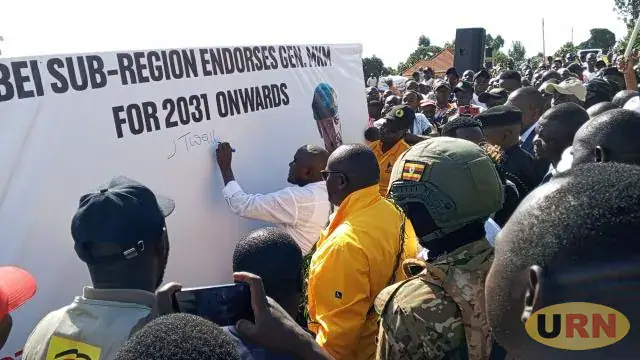
A recent online debate in Uganda has highlighted the use of strawman arguments and social media zingers to avoid engaging with the law on the Patriotic League of Uganda (PLU) and General Muhoozi Kainerugaba's chairmanship. Morrison Rwakakamba, a coffee farmer and commentator, had argued that the specific constitutional and statutory boundaries governing the PLU and General Kainerugaba's chairmanship need to be examined. He laid out the tests that distinguish a pressure group or civic organization from a political party under the Act.
The response on social media, however, did not engage with the law, instead using the straw man method to dismiss Rwakakamba's arguments. This rhetorical fallacy involves deliberately avoiding an opponent's real position and replacing it with an oversimplified and twisted caricature that is easier to destroy. Critics claimed that Rwakakamba was advocating for total military control, dismissing his argument as "regime sycophancy" and "intellectual prostitution." This approach has long crippled political dialogue in Uganda, where complex issues are often reduced to simplistic and emotive soundbites.
The straw man method operates in three distinct steps: extraction, exaggeration, and execution. Critics strip away qualifying statutory clauses, legal exceptions, and contextual boundaries from the original argument, refashion the remaining fragment into an unreasonable extreme, and then dismantle their self-manufactured absurdity. This practice has been used in various national debates in Uganda, including discussions on federalism, land amendment bills, and emergency relief distribution during COVID-19 lockdowns.
The debate on the PLU and General Kainerugaba's chairmanship has also raised concerns about selective enforcement of the law. Critics have asked why one group appears to mobilize freely while opposition entities face strict restrictions. While this is a valid civic concern, it confuses two distinct questions: whether a statutory distinction exists in law and whether that law is being applied evenly across the board. The proper constitutional remedy for selective enforcement is not to ignore existing legal definitions but to demand that statutory standards be applied uniformly to everyone.
To build genuine common ground, Uganda requires a shared, inclusive framework where disagreements are mediated rationally. This can be achieved through three concrete steps: legislative refinement, a higher standard of debate, and efforts at establishing a framework for a genuine and inclusive national dialogue. Parliament must systematically resolve statutory ambiguities between civic pressure groups and political organizations within the Political Parties and Organizations Act.
Public commentators and institutional leaders must commit to a higher standard of debate, actively rejecting social media zingers, profanity, and ad hominem attacks as substitutes for reasoned argument. Extremism and fundamentalist tendencies on all sides of the divide must be dissuaded. All political actors must honor institutional fidelity by meeting opposing arguments on the precise terms established by the Constitution. Common ground can only emerge when accurate engagement with the law and democratic norms becomes the baseline of civic participation.
The establishment of a framework for a genuine and inclusive national dialogue may provide a solution to Uganda's instability in the context of succession politics. This dialogue can provide a platform for citizens to engage with the law and democratic norms, and for leaders to commit to a higher standard of debate. By working together, Ugandans can build a more inclusive and rational framework for resolving disputes and addressing civic concerns.
Key points
- The use of strawman arguments and social media zingers is crippling political dialogue in Uganda.
- Legislative refinement is needed to resolve statutory ambiguities between civic pressure groups and political organizations.
- A higher standard of debate and a framework for inclusive national dialogue are necessary for building genuine common ground in Uganda.