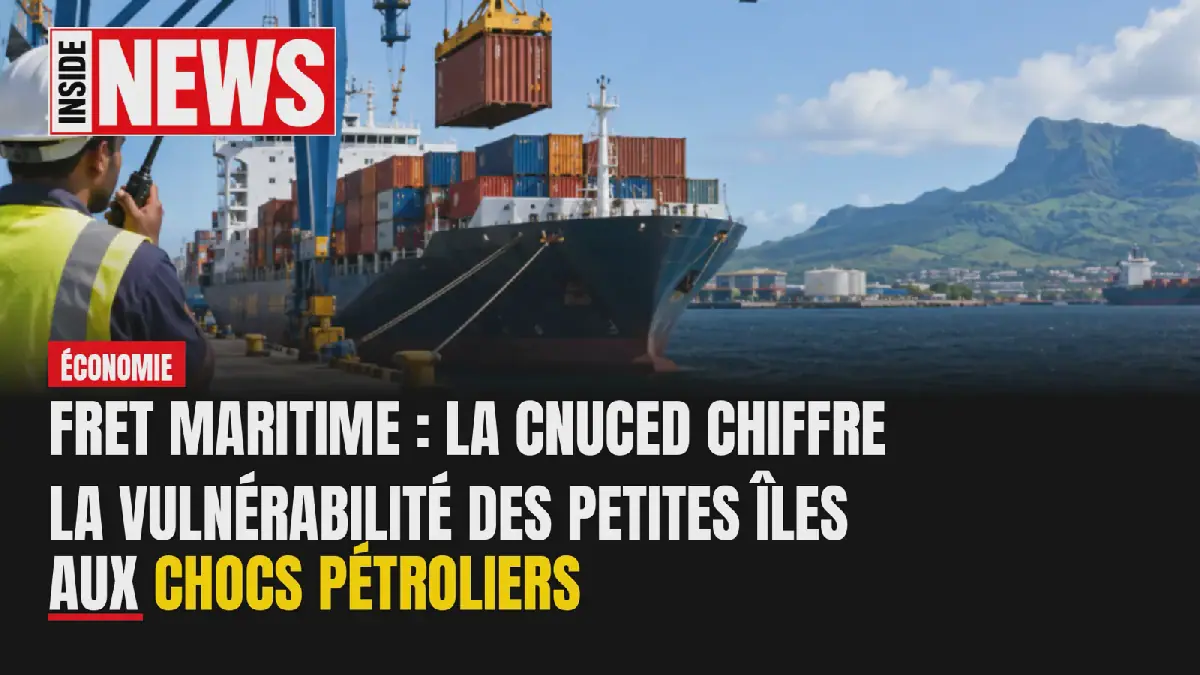
A recent report by the United Nations Conference on Trade and Development (UNCTAD) has highlighted that small island economies, including Mauritius, are more vulnerable to increases in maritime freight costs. The Review of Maritime Transport 2026 report notes that a sustained shock to ship fuel prices could add approximately 0.27% to consumer prices in small island developing states. This finding is based on a model of a group of small island economies using common assumptions, rather than a specific prediction for Mauritius.
The report emphasizes that over 80% of global merchandise trade travels by sea, and disruptions in major shipping routes and straits can lead to longer routes, increased fuel consumption, and higher costs. For small island economies, the fuel cost for maritime transport accounts for around 3.5% of import value, compared to a global average of 3.2%. The frequent use of transshipment ports contributes to this difference.
The 0.27% impact on consumer prices is based on a scenario where maritime fuel costs increase by 70-80% and remain high until the end of 2027. This scenario is comparable to past disruptions, such as those in the Strait of Hormuz in 2026. However, the actual impact on inflation in Mauritius will depend on various factors, including shipping routes, freight contracts, inventory levels, exchange rates, and competition among importers.
The UNCTAD report also forecasts that global maritime trade growth will be zero in 2026, following a 1.9% increase in 2025. Container shipping rates have surged, with the global index more than doubling between January and August, and rates between Shanghai, the Persian Gulf, and the Red Sea increasing fivefold between February and August.
These changes do not affect all economies equally, with those heavily reliant on imports of food and energy being more severely impacted. The report recommends that governments and operators closely monitor shipping rates, available capacity, surcharges, transit times, and port connectivity. For Mauritius, establishing a dashboard combining data from the port, customs, transporters, and importers could help distinguish between temporary and sustained increases in costs.
The UNCTAD report stresses the importance of integrating resilience into infrastructure and supply chain planning. For Mauritian households, the issue is concrete: limiting the pass-through of external logistics shocks to the prices of essential products. The report's findings highlight the need for proactive measures to mitigate the impact of potential shocks on the economy.
The UNCTAD Review of Maritime Transport 2026 provides valuable insights for small island economies like Mauritius, emphasizing the need for vigilance and cooperation to address the challenges posed by increasing maritime freight costs. By understanding these risks and taking steps to mitigate them, countries can work towards building more resilient economies.
Key points
- Small island economies are more vulnerable to increases in maritime freight costs due to their reliance on imports and transshipment ports.
- A sustained increase in ship fuel prices could add approximately 0.27% to consumer prices in small island developing states.
- The UNCTAD report recommends integrating resilience into infrastructure and supply chain planning to mitigate the impact of potential shocks.