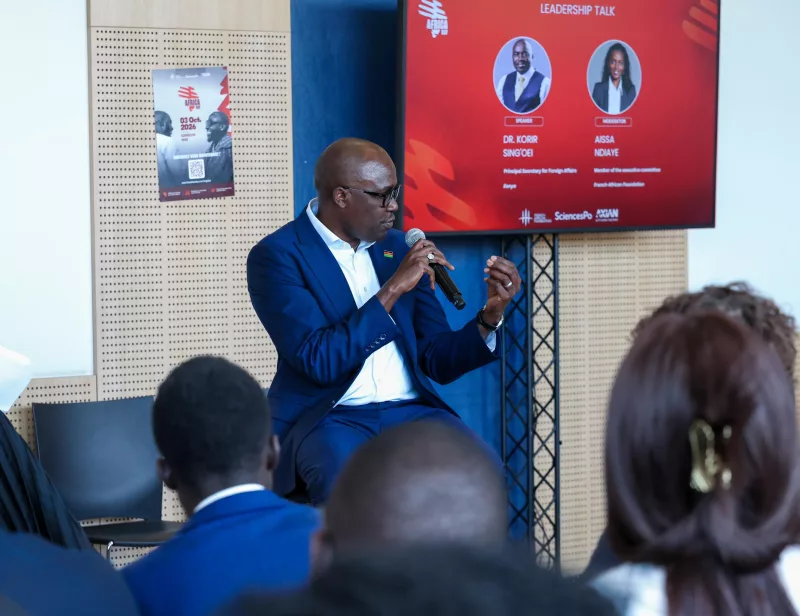
Foreign Affairs PS Dr Korir Sing’Oei has called for reforms to the global financial and diplomatic system, arguing that Africa's economic rise requires a level playing field rather than charity or preferential treatment. Speaking to scholars and future international leaders at Sciences Po in Paris, Sing'Oei said Africa was undergoing a transformation that required global partners to rethink how they engage with the continent. He framed the current global environment as one of both opportunity and crisis.
Sing'Oei identified three key dynamics shaping what he described as Africa's new posture: an awakening, the African advantage and greater African agency. On Africa's awakening, he said the continent was conscious of its history of slavery, colonialism, foreign domination and resource extraction but was determined not to remain defined by its past. He said Africa was increasingly focused on its current capabilities and future potential.
The PS highlighted the continent's youthful population as one of its greatest advantages. With a median age of about 19 years, Africa is the world's youngest continent and possesses significant green mineral reserves, energy resources and blue economy potential. He pointed to the African Continental Free Trade Area (AfCFTA) as an important instrument for harnessing these advantages by creating the world's largest single market.
However, Sing'Oei warned that Africa's economic transformation remained constrained by inequalities embedded in the international financial system. He argued that African countries continue to face significantly higher costs of accessing capital compared with developed economies. According to the figures presented by the PS, African countries pay three to four times more to access capital because of what he described as biased risk pricing.
Sing'Oei further said sovereign debt was capped at between 12 and 13 per cent in Africa, compared with between four and six per cent in OECD countries. African borrowing costs also rose by 91 per cent between 2020 and 2024, largely driven by currency volatility, he said. Sing'Oei argued that addressing such disparities was essential if international partnerships were to support Africa's industrialisation and economic transformation.
The PS also cited Kenya's relationship with France as an example of what he described as a modern partnership based on mutual respect and shared interests rather than paternalism. He said Kenya's growing role as a regional hub for diplomacy, trade and peace had created opportunities for deeper cooperation with France and Europe. According to Sing'Oei, modern diplomacy must extend beyond government-to-government agreements to include human, technological and cultural connections.
Sing'Oei concluded by urging the next generation of leaders to recognise that the future of international relations would be shaped by deliberate choices rather than fate. He said Africa was not seeking handouts but equal treatment in global markets. The PS also highlighted growing African efforts to strengthen the continent's financial and economic institutions, including initiatives to establish independent mechanisms for assessing African creditworthiness.
Key points
- Africa needs a fairer global financial system to support its economic transformation.
- African countries face significantly higher costs of accessing capital compared to developed economies.
- The continent's youthful population and resources are key advantages for its economic growth.