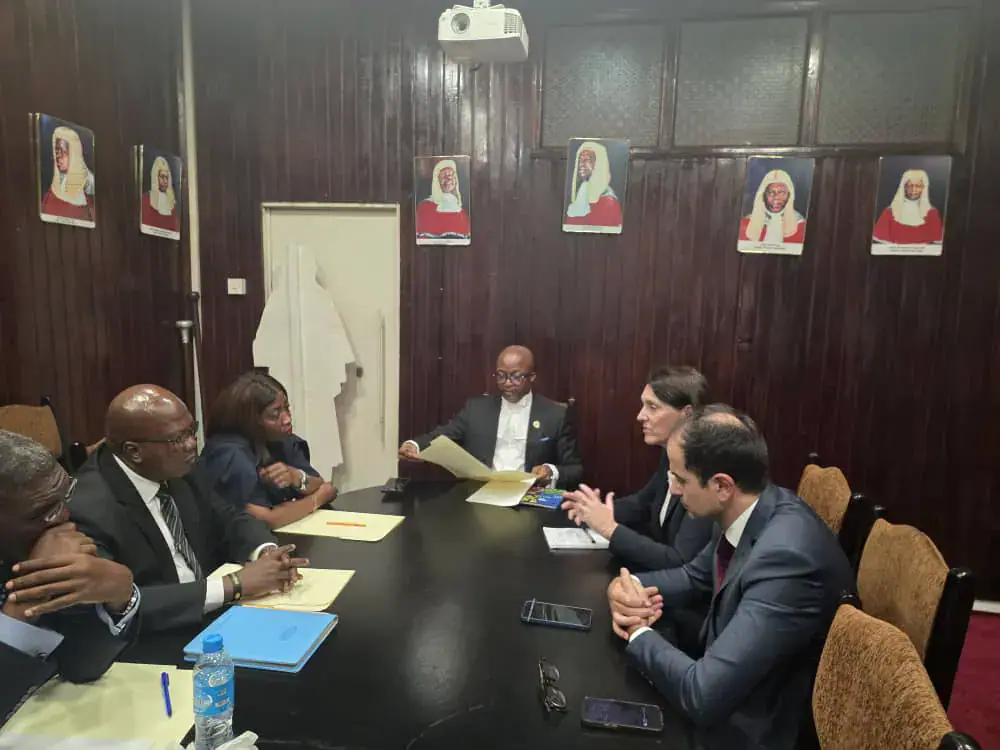
Sierra Leone's most senior judges have requested assistance from the United Nations to establish a specialised drug court and fund a justice-sector colloquium. This move aims to combat the Kush trafficking menace, which has overwhelmed the country's courts. Chief Justice Komba Kamanda and other judges met with a UN Office on Drugs and Crime delegation led by Regional Representative Sylvie Bertrand to discuss the proposal. The judges acknowledged that the current court system alone cannot dismantle the trafficking networks.
The proposed specialised court would build on the Chief Justice's December 2025 Practice Direction, which introduced measures to expedite trials and increase conviction rates. The directive bars bail for drug offences, mandates High Court trials, authorises Saturday sittings, and imposes a minimum 30-year sentence for certain offences under the National Drugs Control Act 2008. Court of Appeal Justice Tonia Barnett cited this direction as a foundation for faster trials and higher conviction rates.
However, Justice Khalila Diana Kamara noted that technical assistance is needed to strengthen institutional capacity, particularly in the Attorney-General's office and the Sierra Leone Correctional Service. Justice Andrew Johnson highlighted a practical challenge: the shortage of professional witnesses, such as police officers required to testify in multiple courts, which frequently causes adjournments. The judges' requests signal that the judiciary sees its punitive framework as incomplete without dedicated infrastructure and better coordination with police, prosecutors, and corrections.
The UNODC delegation, led by Bertrand, visited Freetown to engage justice stakeholders, identify challenges, and assess successes in addressing drug offences, financial crimes, and law enforcement. Jonathan Bourguignon, UNODC's adviser on corruption and financial crime for West and Central Africa, said the organisation is particularly interested in identifying gaps within the criminal justice chain. The visit comes as Sierra Leone's Kush crisis continues to strain both the justice and health systems.
The Kush crisis has had a significant impact on the country's health system, with Kush-related admissions at the Sierra Leone Psychiatric Teaching Hospital rising approximately 4,000 percent between 2020 and 2023, reaching nearly 1,865 cases. The government declared a public health emergency in April 2024. President Bio has separately announced plans for a Special Court dedicated to drug cases, staffed by designated judges and magistrates to fast-track prosecutions.
The Chief Justice's Practice Direction represents one of the world's harshest drug enforcement regimes, with critics arguing that it prioritises punishment almost exclusively, leaving little room for differentiated responses based on the nature of the offence or the offender. Aiah Nabieu Mokuwah, executive director of the Institute for Drug Control and Human Security, has raised concerns about the directive's impact. Less than two months after implementation, the Judiciary announced 20 convictions, with sentences ranging from 10 years for possession to 40 years for a "collecting" offence.
The meeting between the judges and the UNODC delegation did not produce a formal agreement, but the judges' request for a specialised court and a stakeholder colloquium signals a willingness to collaborate. Whether UNODC responds with funding and technical support—and whether a specialised court materialises—will determine if Sierra Leone's drug strategy moves beyond incarceration toward a functioning justice chain. The outcome will be crucial in addressing the Kush crisis and its impact on the country's justice and health systems.
Key points
- Sierra Leone's senior judges are seeking UN assistance to establish a specialised drug court and fund a justice-sector colloquium to combat Kush trafficking.
- The proposed specialised court would build on the Chief Justice's December 2025 Practice Direction, which introduced measures to expedite trials and increase conviction rates.
- The Kush crisis has had a significant impact on Sierra Leone's health system, with a 4,000 percent rise in Kush-related admissions at the Sierra Leone Psychiatric Teaching Hospital between 2020 and 2023.