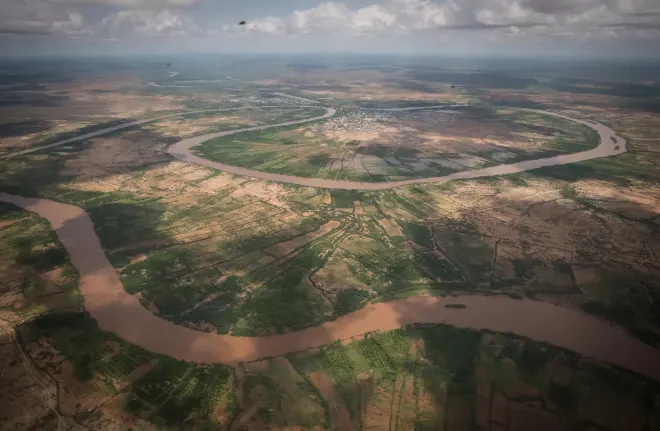
The Shabelle River at Jowhar has risen from 2.48 meters to 4.70 meters over the past week, an increase of 2.22 meters, according to the Somalia Water and Land Information Management weekly forecast covering Oct. 7-13. This leaves the river just 30 centimeters below the moderate flood-risk threshold of 5 meters and 55 centimeters below the high-risk level of 5.25 meters. The pace of the rise has slowed, however, from about half a meter on Oct. 4 to 20 centimeters on Oct. 7.
The increase comes as Somalia enters the October-to-December Deyr rainy season under heightened concern about El Niño-related flooding. The Food and Agriculture Organization (FAO) warned last month that some parts of central and southern Somalia have as much as a 90% probability of receiving above-normal seasonal rainfall, with the Juba and Shabelle river basins among the areas of particular concern.
FAO-SWALIM’s latest forecast, based on the U.S. National Oceanic and Atmospheric Administration’s Global Forecast System model, projects moderate to heavy rainfall over much of Somaliland, Bay, Bakool and Hiiraan, as well as inland central Somalia. Heavy rainfall is also expected in parts of the Ethiopian highlands, an important development because rainfall upstream can raise the Juba and Shabelle rivers in Somalia even when local rainfall is limited.
Along the Shabelle, levels at other monitoring stations remained well below flood thresholds. At Belet Weyne, the river stood at 4 meters after reaching 4.16 meters on Oct. 3 and falling to 3.78 meters two days later. The latest reading is 2.50 meters below the moderate flood-risk threshold of 6.50 meters. The level is also 1.90 meters lower than on the same date last year and about half a meter below the long-term average for early October.
Upstream at Deefow, the river remained broadly stable at 2.70 meters, compared with 2.73 meters a week earlier. It was 3.80 meters below the moderate flood threshold. Bulo Burti recorded a more pronounced increase, rising 62 centimeters during the week to 3.20 meters, though it remained 3.30 meters below the moderate flood-risk level.
Conditions along the Juba River were comparatively stable. At Dollow, the river rose from 2.54 meters to 2.64 meters during the week and remained 1.86 meters below its moderate flood threshold of 4.50 meters. At Luuq, levels were virtually unchanged, increasing from 2.34 meters to 2.36 meters and remaining more than 3 meters below the moderate flood-risk mark.
Rainfall has already begun earlier than usual in some areas, with Bardhere in Gedo recording 93 millimeters of rain during the first five days of October, while Galkayo received 50 millimeters, with both locations exceeding their normal rainfall totals for the entire month within those first five days. Authorities and humanitarian organizations have been urged to use current forecasts to reinforce river embankments, prepare evacuation routes, identify safe areas and position emergency supplies before river levels reach dangerous thresholds.
Key points
- The Shabelle River at Jowhar is approaching flood-risk levels, with a moderate flood-risk threshold of 5 meters.
- FAO warned of a 90% probability of above-normal seasonal rainfall in some parts of central and southern Somalia.
- Authorities and humanitarian organizations are urged to prepare for potential flooding by reinforcing river embankments and positioning emergency supplies.