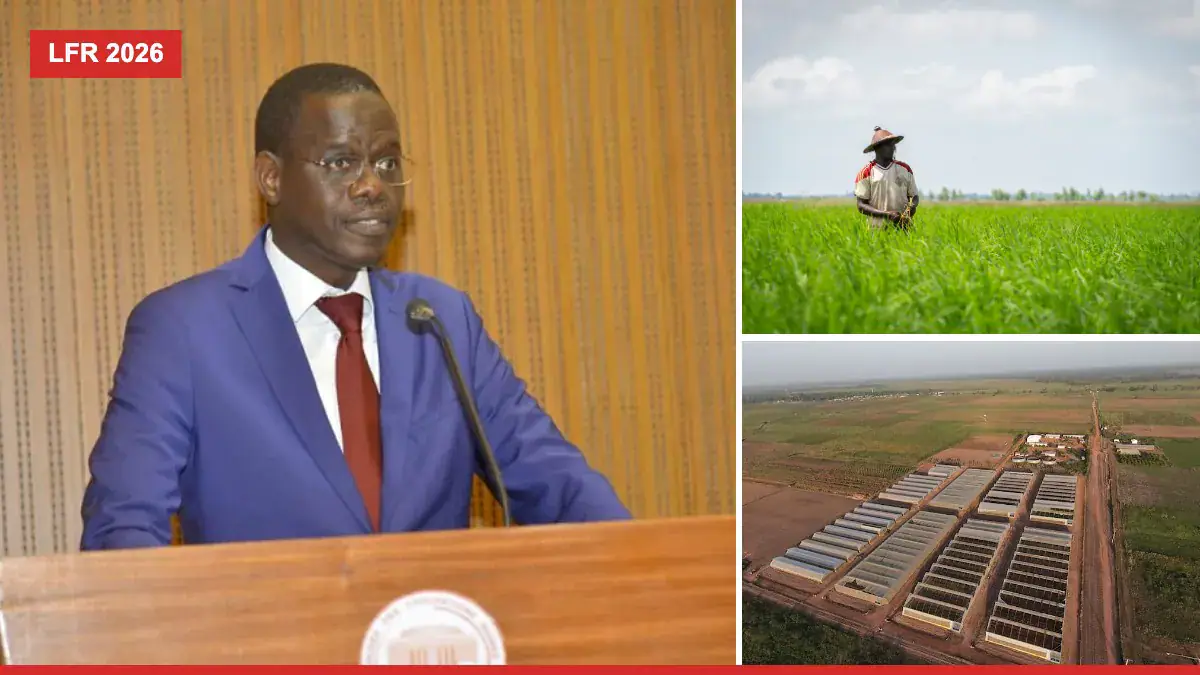
The Senegalese government's proposed 2026 supplementary finance bill (LFR) has been scrutinized for claims of project suppressions. However, an analysis of the official document reveals that several projects initially presented as "suppressed" are still included, with or without allocated credits. The projects in question include Agropoles, rural electrification, and the Grand Transfert d'Eau (GTE). These findings contradict visuals circulating on social media, which claim that the government has eliminated these projects.
A closer examination of the LFR document shows that Agropole Sud retains 7 billion FCFA in engagement authorizations and payment credits. This includes 3 billion FCFA from the African Development Bank (BAD) and the African Development Fund (FAD), and 4 billion FCFA from the Islamic Development Bank (BID). Similarly, Agropole Centre, focused on promoting sustainable entrepreneurship in Sine-Saloum, has 2.5 billion FCFA, comprising 1.5 billion FCFA from the BAD and FAD, and 1 billion FCFA from the BID.
The LFR document also lists several components of rural electrification. These include 2 billion FCFA from the Abu Dhabi Fund for electrification solaire and over 4 billion FCFA from the BID and BOAD for mini-photovoltaic power plants in 177 villages. Additionally, PUELEC 1 has 25 billion FCFA in engagement authorizations. These allocations indicate that the mentioned projects have not been entirely eliminated.
However, some projects, although still listed, do not have allocated external financing for 2026. The Grand Transfert d'Eau (GTE) and Agropole Nord (PZTA-Nord) are included in the nomenclature but lack programmed external disbursements for this year. This does not necessarily imply their cancellation but rather a postponement or reprogramming of their financing.
The Ministry of Economy, Finance, and Planning has addressed the GTE, stating that the 20 billion FCFA initially planned for compensation was withdrawn due to a lack of affected person registration. Instead, 13.8 billion FCFA has been reprogrammed in the 2027 budget project. The Vice-President of the National Assembly, El Malick Ndiaye, had previously denounced a 50 billion FCFA reduction in the GTE.
Some operations cited in the visuals, such as the Mékhé-Pékess-Thilmakha road, construction of 35 health centers, or mil and peanut value chains, are not listed individually. The finance law operates on a program budget, grouping these into broader lines like "Quality Healthcare Offer" or "Road Infrastructure Development." Their absence from the list does not confirm their suppression.
The LFR project reduces investment expenditures by 555 billion FCFA, targeting projects with slow disbursement rates or deemed non-priority. This reduction does not necessarily imply the definitive suppression of projects but rather a decrease or postponement of their financing. The Prime Minister, Ahmadou Al Aminou Lo, is set to present the project's decisions on Sunday at 4 PM.
Key points
- Several projects initially presented as "suppressed" in Senegal's 2026 LFR are still listed with allocated credits.
- The LFR document reveals that some projects lack allocated external financing for 2026 but are not necessarily canceled.
- The reduction of 555 billion FCFA in investment expenditures targets projects with slow disbursement rates or deemed non-priority.