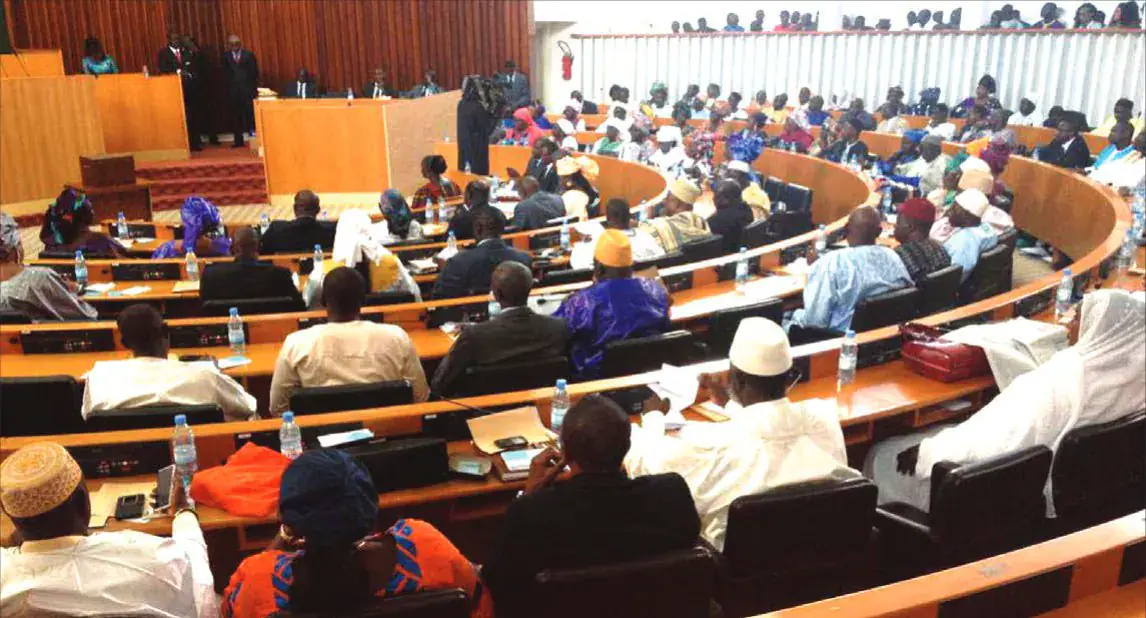
The Senegalese parliament has rejected the government's decree for the 2026 budget, with 128 votes against the decree, 9 votes in favor, and 2 abstentions. The decree, issued by President Bassirou Diomaye Faye on November 19, 2026, was rejected by the ruling Pastef party, which holds a majority in the parliament. The party's leader, Ousmane Sonko, had previously expressed concerns about the decree.
The rejection of the decree is based on Article 103 of the parliament's internal regulations, which allows the parliament to adopt a resolution on the government's budget plans. The resolution, defended by Ayib Daffé, the leader of the Pastef group, argues that the decree does not follow the constitutional rules and could lead to "usurpation budgétaire". Daffé also warned that any officials who implement the decree without proper authorization could face consequences.
Several lawmakers from the Pastef party expressed concerns about the decree, with some describing it as a "dangereux précédent" that could undermine the country's democracy. El Hadj Ousmane Fall described the decree as an attempt to "piétiner la démocratie sénégalaise", while Bakary Diédhiou accused President Diomaye of trying to use the constitution as a "jouet".
However, not all lawmakers from the Pastef party agree with the rejection of the decree. Félicité Bougar Diouf, a member of Pastef close to President Diomaye, accused the party of trying to "couler le Sénégal" and described the rejection as a "haute trahison". She also warned that the move could harm the country's economy and drive away investors.
Other lawmakers, including Adama Diallo and Djimo Souaré, expressed skepticism about the effectiveness of the resolution, arguing that it cannot annul the decree and that the issue may need to be taken to the Supreme Court. Souaré also criticized the opposition for engaging in "politique politicienne" and trying to intimidate civil servants.
Tafsir Thioye, a non-inscrit deputy, pointed out that the procedure used by the parliament to adopt the resolution was flawed, as it was not provided for in the internal regulations. He argued that a constitutional amendment would be needed to allow the parliament to take such resolutions.
The rejection of the decree has sparked concerns about the country's budget and economic plans, with some lawmakers warning that it could have negative consequences for the population. The government will need to find a way to address the concerns of the parliament and find a solution that works for all parties.
Key points
- The Senegalese parliament has rejected the government's decree for the 2026 budget, citing concerns about its constitutionality and the potential for "usurpation budgétaire".
Reporting sources
- WalFadjri · WalFadjri