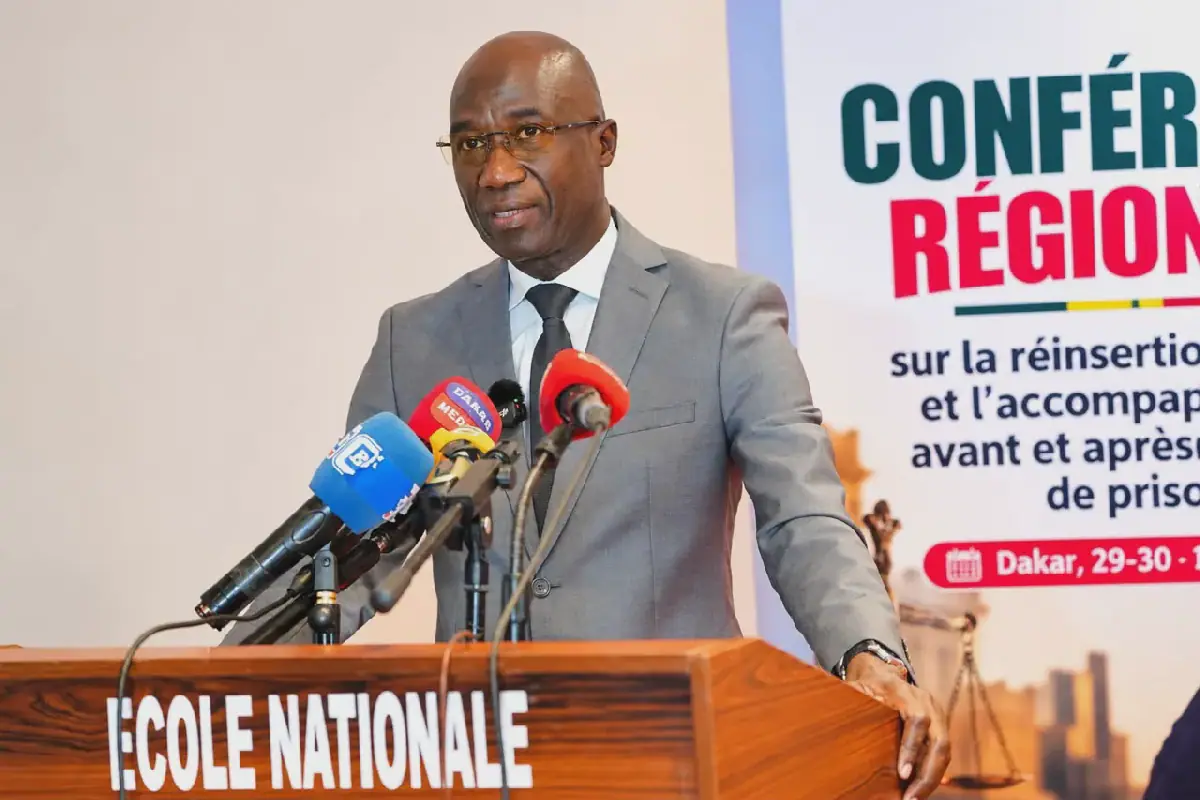
On October 29, 2026, Senegal's Justice Minister, Me Moussa Sarr, emphasized the need to rethink the purpose of imprisonment, focusing on human dignity, education, and rehabilitation to prevent recidivism. At the opening of a regional conference on social reintegration and support for individuals before and after prison release, he advocated for a penitentiary policy that prioritizes the reintegration of inmates into society. This approach involves strengthening the means of the penitentiary administration, developing vocational training, and increasing access to education.
Me Moussa Sarr highlighted the challenges faced by individuals upon release from prison, including finding employment, housing, and reconnecting with their community. He stressed that detention should not only be a time of punishment but also a period of preparation for reintegration into society. The minister's vision aligns with the United Nations' Nelson Mandela Rules, which emphasize the importance of preparing inmates for social reintegration. He also cited the President of the Republic, Bassirou Diomaye Diakhar Faye's vision for respecting the dignity of individuals deprived of liberty.
The conference, which brings together representatives from Germany, Morocco, Tunisia, and Algeria, aims to share experiences and examine mechanisms for supporting individuals before and after prison release. Me Moussa Sarr's approach seeks to balance punishment with the need to rebuild and rehabilitate inmates. He emphasized that security and discipline in prisons must be accompanied by genuine efforts to support inmates. The minister also announced the authorization of 418 recruitments within the penitentiary administration for 2026.
To implement an ambitious reintegration policy, Me Moussa Sarr stressed the need for sufficient human resources and well-trained personnel. The recruitments include two inspectors, six controllers, ten administrative agents, and 400 guards. These new recruits will help alleviate the workload of existing personnel and improve working conditions. The minister praised the role of penitentiary agents, who not only maintain order but also identify individual needs and support rehabilitation efforts.
In Senegal, several initiatives have been launched to provide inmates with vocational training and education. These include baking, dairy production, industrial training, mechanical workshops, and sewing classes. The minister also mentioned plans to engage with the Ministry of Higher Education to allow inmates with a baccalaureate to pursue studies at the University numérique Cheikh Hamidou Kane. Additionally, discussions with the Ministry of National Education will aim to mobilize teachers to support inmates preparing for exams.
Me Moussa Sarr emphasized that education and vocational training are essential for preparing inmates for a second chance at life. He stated that "privation of liberty must not mean privation of knowledge." By providing inmates with skills and education, the government aims to facilitate their reintegration into society and reduce recidivism. The minister's vision is aligned with the President's orientation that "freedom remains the principle and detention the exception."
The implementation of these initiatives will require collaboration between various government agencies and stakeholders. Me Moussa Sarr's advocacy for rehabilitative prisons reflects a broader effort to reform the penitentiary system in Senegal. By prioritizing education, vocational training, and social reintegration, the government aims to create a more effective and humane approach to justice.
Key points
- Senegal's Justice Minister Me Moussa Sarr advocates for prisons that prioritize education, vocational training, and social reintegration to prepare inmates for life after release.