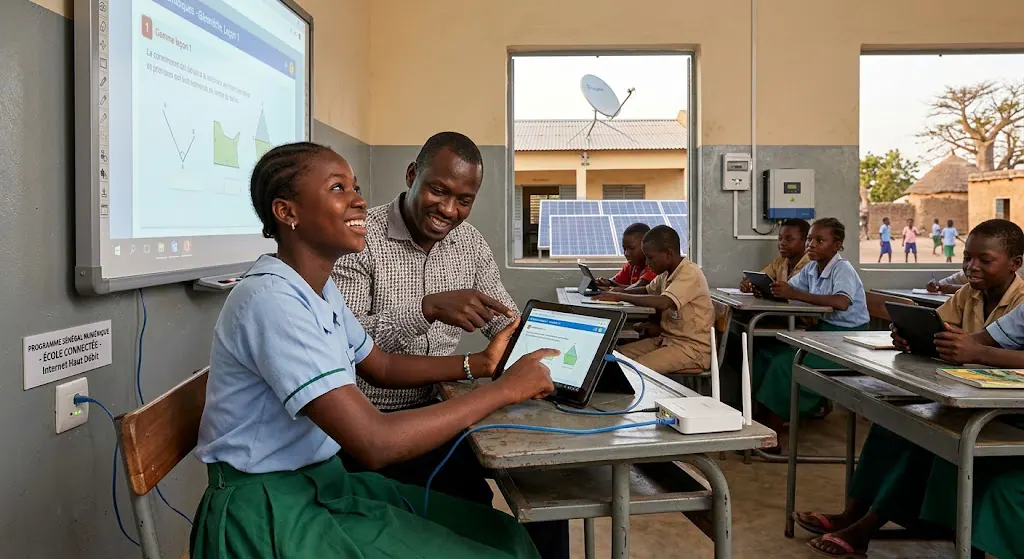
The Senegalese government has announced plans to bridge the digital divide in the education sector by connecting 6,888 schools and institutions to high-speed internet. This initiative was revealed during a meeting of the Interministerial Council for preparations for the 2026-2027 school year. The move aims to enhance digital learning and provide equal opportunities for students across the country.
As part of its efforts to improve educational infrastructure, the government has made significant progress through the Program for Improving the School Environment. This program has led to the construction of 14 complete elementary schools, three colleges, six high schools, and two scientific and technological blocks. Additionally, 14 establishments have been rehabilitated, and 1,305 classrooms, 220 administrative blocks, and 250 hygiene blocks have been built.
The government's focus on digitalization is further evident in its distribution of 6,547 pedagogical tablets and training of 12,385 teachers in digital skills and artificial intelligence. These efforts are part of the National Digital Strategy for Education 2025-2029, which seeks to integrate technology into the learning process. The strategy also includes the deployment of satellite solutions to cover over 2,000 schools.
The Minister of National Education, Moustapha Guirassy, highlighted the progress made in implementing the Harmonized Bilingual Education Model in Senegal (Mohebs). This model has been deployed in 1,958 schools, promoting bilingual education and enhancing learning outcomes. Furthermore, the minister announced the availability of an artificial intelligence platform called "Allô Gorgui," which can be accessed via mobile phones, even without an internet connection.
The "Allô Gorgui" platform is designed to support students in both French and Wolof, particularly in science and mathematics. This initiative aims to provide personalized learning experiences and bridge the educational gap in rural areas. The platform's accessibility features will enable students to learn using their mobile phones, making education more inclusive and widespread.
In addition to digitalization efforts, the government has also supported the development of modern daaras, with 1,127 daaras receiving assistance. The construction of 44,000 linear meters of perimeter walls has also been completed, providing a safer learning environment for students. These initiatives demonstrate the government's commitment to improving the quality of education and expanding access to educational resources.
As the 2026-2027 school year approaches, the Senegalese government remains focused on addressing the challenges facing the education sector. With a strong emphasis on digital transformation, infrastructure development, and inclusive education, the government is poised to make a positive impact on the lives of students and teachers across the country.
Key points
- The Senegalese government plans to connect 6,888 schools to high-speed internet as part of its efforts to bridge the digital divide in education.