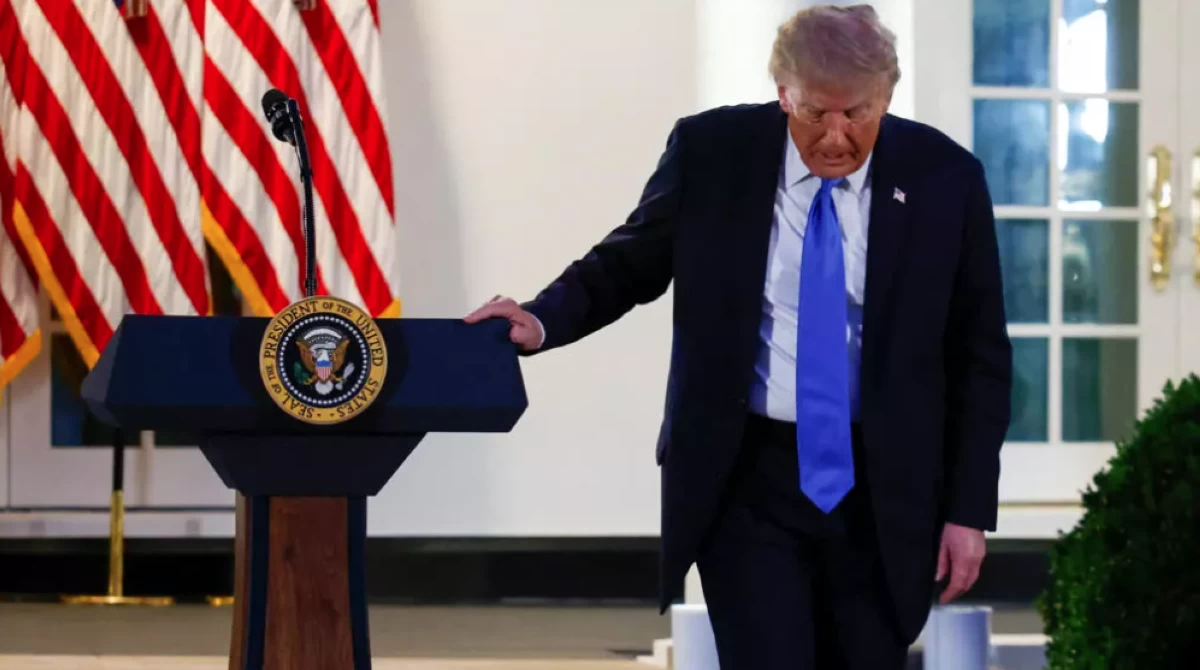
US officials have revealed that President Donald Trump rejected a proposal by Iran for a 7-day ceasefire. The proposal, which was put forth by Iranian officials, aimed to establish a temporary ceasefire and restart negotiations on Iran's nuclear program. In response, Trump informed his aides that he expects to resume airstrikes on Iran after the US midterm elections in November.
The Iranian proposal called for the reopening of the Strait of Hormuz and the resumption of nuclear talks in exchange for the US lifting its blockade on Iranian ports, releasing frozen Iranian assets, and easing sanctions on Iranian oil exports. This proposal was made in an effort to de-escalate tensions between the two nations, which have been heightened in recent months.
According to US officials, Trump is hesitant to engage in large-scale military operations against Iran, partly due to concerns about the dwindling US munitions stockpile. The US is wary of becoming embroiled in another conflict, and is therefore exercising caution in its dealings with Iran. This stance was reported by Radio Monte Carlo.
Iranian Foreign Minister Abbas Araghchi confirmed that his country had presented a plan to the Trump administration to reopen the Strait of Hormuz within 7 days. In a separate interview with CBS News, Iranian President Masoud Pezeshkian stated that Iran has no intention of developing nuclear weapons and will permit inspectors from the International Atomic Energy Agency to enter the country.
Pezeshkian emphasized that Iran will adhere to any commitments it makes if the US accepts the latest Iranian proposal regarding the reopening of the Strait of Hormuz. However, he noted that there is a lack of trust between Tehran and Washington, which complicates negotiations. The two nations have had a strained relationship in recent years.
The Islamic Revolutionary Guard Corps (IRGC) has declared that Iran is the "victor" in the conflict, claiming control over the Strait of Hormuz and working to convert this victory into a lasting strategic deterrent. The IRGC's statement reflects Iran's confidence in its military capabilities and its determination to assert its influence in the region.
The rejection of Iran's ceasefire proposal has significant implications for the future of US-Iran relations. The two nations have been at odds over Iran's nuclear program and the US presence in the region, and tensions have escalated in recent months. The situation remains volatile, with both sides dug in and unwilling to compromise.
Key points
- The US has rejected Iran's proposal for a 7-day ceasefire.
- The proposal called for the reopening of the Strait of Hormuz and the resumption of nuclear talks.
- Trump is hesitant to engage in large-scale military operations against Iran due to concerns about the US munitions stockpile.