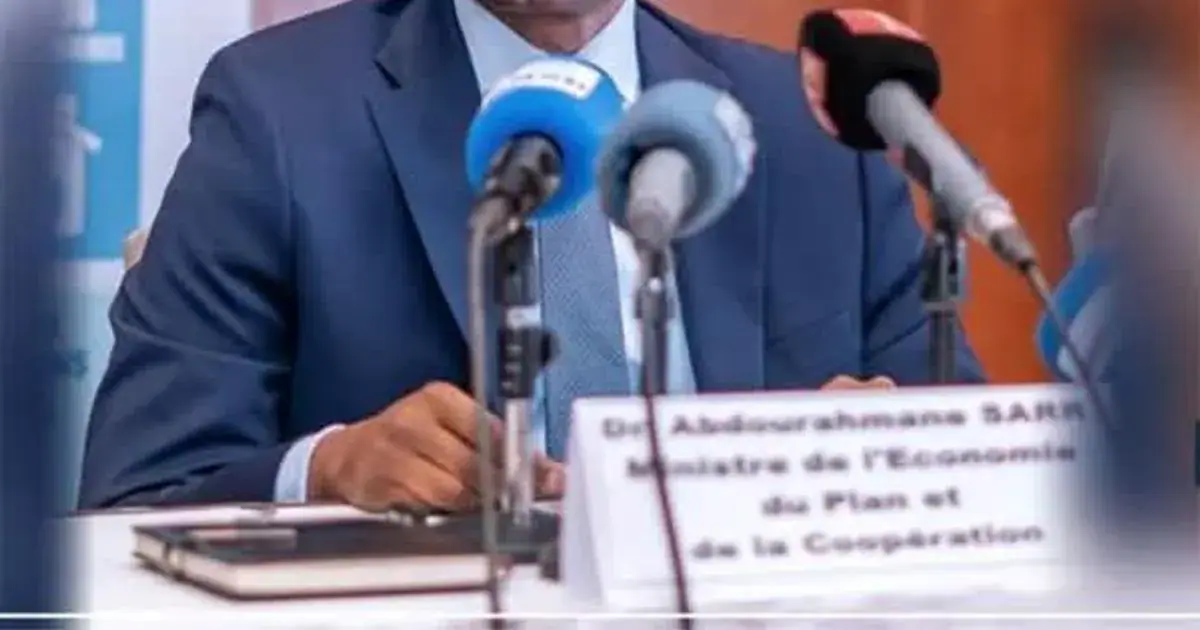
Senegal is facing a critical juncture in its budgetary planning as tensions between the executive and parliamentary majority have escalated. The disagreement centers around the 2026 revised finance law and the 2027 initial finance law, with the International Monetary Fund (IMF) having already approved the country's budget trajectory. Abdourahmane Sarr, former Minister of Economy, has weighed in on the issue, advocating for a compromise between the parties involved.
Sarr emphasizes that the IMF had given its approval for the 2026 revised finance law and the 2027 initial finance law, which are built around three main priorities: budget sustainability, protection of vulnerable populations, and preservation of priority spending aligned with Senegal's objectives. He suggests that with a revised 2026 budget based on probable realizations, the deficit could be significantly reduced. Furthermore, he estimates that the 2027 deficit could reach 3% of GDP after reassessing the calculation base.
Beyond the budgetary compromise, Sarr calls for a joint commitment from the executive and parliamentary majority to enable the approval of Senegal's program by the IMF's board of directors. He believes that the current political configuration necessitates an agreement between the concerned institutions. Failure to reach an agreement may lead to the dissolution of the National Assembly on December 2, allowing the Senegalese people to decide on the impasse.
In a post on X, Sarr invited the executive and parliamentary majority to find a compromise on public finances, amidst tensions over the 2026 revised finance law. He expressed his concerns about the country's financial situation and proposed a dissolution of the National Assembly if a compromise is not reached. According to him, this would allow the Senegalese people to arbitrate the dispute, which he considers a political impasse.
Sarr maintains that Senegal's debt is viable and can be refinanced without restructuring. He points to the resources mobilized under the PRES, which he estimates have contributed to strengthening the country's financial resilience. The PRES resources would have added 300 billion to the 955 billion collected between 2025 and 2026. These resources also helped mitigate a significant shock related to subsidies, estimated at nearly 600 billion FCFA.
The former minister expects 2027 to be a turning point with the implementation of the National Development Strategy (SND) in a context of assorted public finances. He considers that the country has made significant progress and is ready to move forward. Sarr's proposals come at a time when the country is navigating a delicate phase in its economic planning.
As the deadline for a resolution approaches, the situation remains uncertain. The Senegalese government will have to make a critical decision regarding its budget and its relationship with the IMF. With the proposed dissolution of the National Assembly, the country's future hangs in the balance, and all eyes are on the developments set to unfold in the coming weeks.
Key points
- Abdourahmane Sarr proposes a compromise or parliament dissolution over Senegal's budget disagreements.
- The IMF had approved Senegal's budget trajectory for 2026 and 2027.
- Sarr believes Senegal's debt is viable and can be refinanced without restructuring.