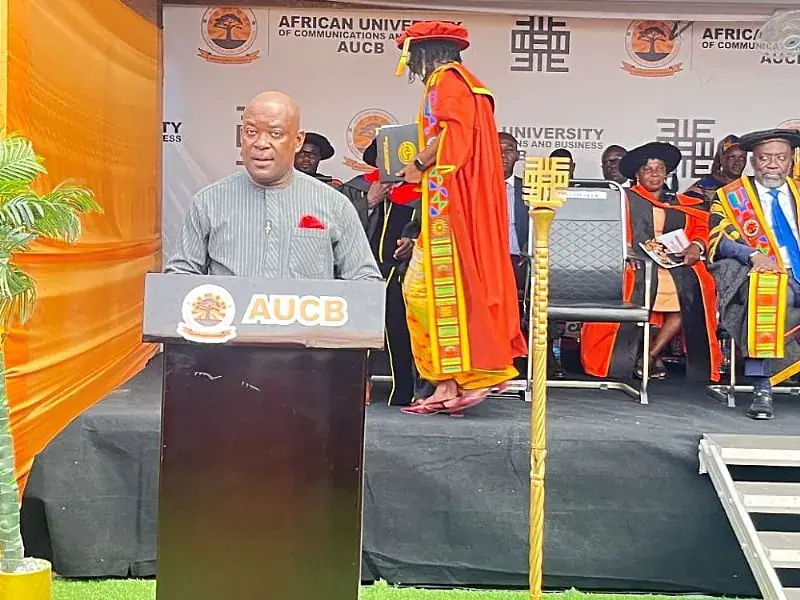
The Ghana Tertiary Education Commission (GTEC) has warned universities in Ghana to stop over-enrolling PhD students, citing concerns that the practice could undermine the quality and credibility of doctoral education. According to GTEC's Director-General, Professor Ahmed Abdulai Jinapor, the expansion of doctoral programmes must be matched with adequate numbers of qualified supervisors, research facilities, library resources, and funding. This warning was given at the graduation ceremony of the African University of Communication and Business in Accra.
Professor Jinapor emphasized that doctoral education is essential for producing future researchers, lecturers, and policy thinkers, but universities must not compromise academic standards in their drive to increase enrolment. He stressed that growth in numbers must never outpace capacity and that doctoral qualifications require years of rigorous study, original research, and examination. As such, they should not be treated as commercial products. Instead, universities should ensure that doctoral admissions reflect their actual capacity.
The GTEC Director-General also highlighted the importance of technology in higher education, urging universities to adapt their teaching and research approaches to prepare graduates for an increasingly technology-driven economy. He cited artificial intelligence, automation, big data, digital platforms, and cybersecurity as areas reshaping professional and economic activities. To remain relevant, institutions must equip students with relevant skills in these areas.
While acknowledging the potential of online, blended, and distance learning to expand access to tertiary education, Professor Jinapor cautioned that digital delivery must not become a means of lowering academic standards. He emphasized that online degrees must carry the same value as qualifications obtained through traditional campus-based programmes. To achieve this, accredited programmes, qualified faculty, reliable digital platforms, credible assessment systems, and adequate learner support are necessary.
Professor Jinapor also disclosed that GTEC has intensified public education on recognised institutions and accredited learning centres to protect prospective students from enrolling in unaccredited programmes. In July 2026, GTEC published a notice concerning 15 unaccredited learning centres and institutions whose institutional accreditation had expired. This was followed by an updated list of 110 unrecognised institutions in September 2026.
The graduation ceremony of the African University of Communication and Business in Accra saw 350 students graduate, comprising 206 undergraduates and 144 postgraduate students. The ceremony was held on the theme, “Transforming Higher Education for a Resilient Nation: Leveraging Technology for Sustainable Development.” During the ceremony, the university's Overall Best Graduating Student, Barbara Kafui Abram, shared her story of perseverance.
Barbara Kafui Abram, who graduated from the Faculty of Strategic Communication, urged her fellow graduates not to allow past academic setbacks to discourage them from pursuing their ambitions. Drawing on her experience of an earlier unsuccessful tertiary education attempt, she advised that perseverance and the willingness to start again had been central to her eventual achievement.
Key points
- GTEC warns universities against over-enrolling PhD students.
- Expansion of doctoral programmes must match capacity.
- Quality rather than quantity must guide postgraduate education.