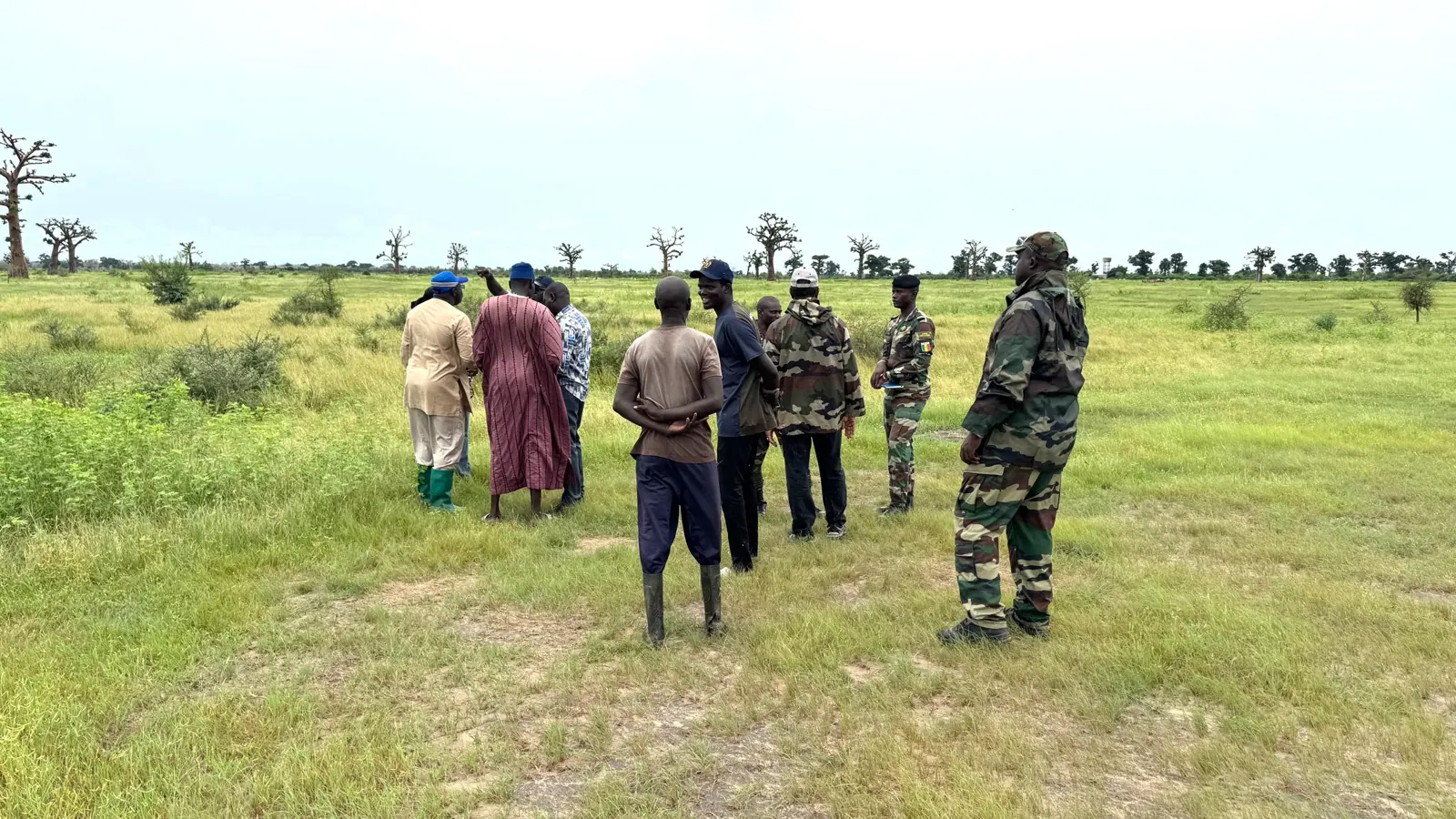
The land dispute in Ndingler, a village in the commune of Ndiaganiao, Senegal, has been resolved, paving the way for the land's redevelopment. A joint mission from the Ministry of Agriculture, Food Sovereignty, and Livestock (MASAE) and the Military Engineering Corps recently visited the site to assess the work required to restore it to cultivation. The area has been idle for years, and the rains have made access difficult. The land needs various forms of preparation, including clearing, stump removal, leveling, decompacting, and loosening of the soil.
Before the heavy machinery can start working, a priority has emerged: demarcating the 80 hectares and allocating specific plots to the beneficiary families. This step aims to enable technical teams to work on a clearly defined area and secure land allocation. The process involves collaboration between multiple stakeholders to ensure a smooth transition. The site's history is complex, with Babacar NGOM, founder of the SEDIMA group, having previously renounced his claim to the land on January 29, 2026.
NGOM's decision to relinquish the land was voluntary and unconditional, in the interest of the general public. Although his group remains the legal owner of the land, acquired through regulatory procedures, NGOM chose to prioritize a peaceful resolution. The joint mission involves experts from various fields, including the Military Engineering Corps, led by Colonel BIAYE. They are evaluating the mechanical resources that can be mobilized for the heavy work required to restore the land.
The mission aims to expedite the process of making the land arable again. With 39 families set to benefit, the project is expected to have a positive impact on the local community. The MASAE and Military Engineering Corps are working together to ensure the successful implementation of the project. The site's restoration will involve significant groundwork, including decompacting and loosening of the soil to make it suitable for farming.
The project's success depends on effective coordination between stakeholders. The joint mission has assessed the site and identified the necessary steps to move forward. With the land's history of disputes now behind it, the focus has shifted to productive use. The 80 hectares will be divided into plots for the beneficiary families, who are expected to start farming once the land is ready.
Khadydja NDIAYE is among the officials involved in the project. The joint mission has brought together experts with diverse expertise to ensure the project's success. The project's impact on the local community will be significant, with 39 families set to benefit from the restored land. The Senegalese government's efforts to revive the land and make it productive again are expected to have a lasting impact on the area.
The project's progress will be closely monitored, with the joint mission working to ensure that the land is restored to its full potential. With the site's history of disputes now behind it, the focus has shifted to productive use. The project's success will depend on effective coordination between stakeholders and the continued involvement of experts from various fields.
Key points
- The Senegalese government has resolved the land dispute in Ndingler, paving the way for 39 families to cultivate 80 hectares of land.