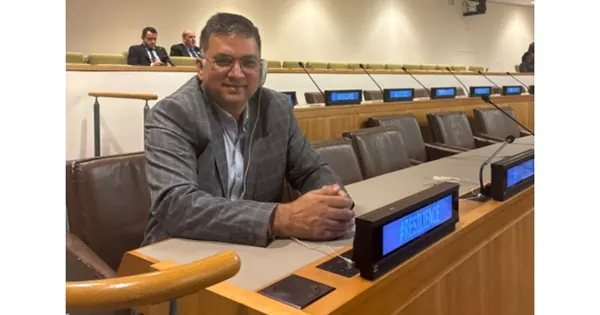
Shri Binod Anand, Secretary General of the Confederation of NGOs of Rural India (CNRI) and Founder & Executive President of the World Cooperative Economic Forum (WCOOPEF), recently participated in the United Nations General Assembly deliberations on the Right to Development. During his engagements, he presented India's vision of "Sahkar Se Samriddhi" (Prosperity through Cooperation) as a practical solution to four linked global challenges: Food, Fertiliser, Fuel, and Finance. This vision aims to address the current global crises through cooperative economic frameworks.
The concept of "Sahkar Se Samriddhi" focuses on cooperatives as resilient, community-owned infrastructure that keeps value, data, and decision-making in the hands of producers. Shri Anand argued that geopolitical tensions are disrupting supply chains, raising input costs, and tightening credit for the Global South. In this context, cooperatives can serve as a stable foundation for economic development. He also emphasized that cooperatives are not just welfare institutions but strategic economic architecture.
At the centre of Shri Anand's interventions was the Cooperative Economic Framework (CEF) developed by CNRI. This framework treats cooperatives as more than just welfare institutions; it sees them as transparent local markets, member-owned finance, and farmer-controlled supply chains. These elements strengthen economic sovereignty and reduce the space for exploitation, market capture, and financial crime. The framework aims to empower farmers and local communities by giving them control over their economic activities.
Shri Anand's discussions covered the entire value chain, from farming, dairy, fisheries, and fertiliser access to rural credit, cooperative insurance, and green energy. He highlighted the importance of cooperative models in addressing the interconnected crises of food, fertiliser, fuel, and finance. According to him, these crises are no longer separate problems but are linked in a geoeconomic chain. Whoever controls this chain has significant influence over the fate of billions of small producers.
During his meetings with senior management of UN DESA, Shri Anand proposed a strategic collaboration on "Cooperatives as Infrastructure for Inclusive, Digital, and Sustainable Development." This collaboration includes several initiatives such as a Global South Cooperative Policy Lab, a Cooperatives & VNRs Toolkit, a UN-Global South Cooperative Development Dialogue, and a Coop-Eco Digital & AI Literacy Mission. A 12-month pilot project has been proposed to test these initiatives.
The Confederation of NGOs of Rural India (CNRI) holds Special Consultative Status with the UN Economic and Social Council (ECOSOC) and has been an Affiliate Member of the OECD International Network on Financial Education (OECD/INFE) since 2011. WCOOPEF, founded by Shri Anand, is a global not-for-profit platform dedicated to advancing cooperative economics worldwide. These affiliations enhance CNRI's and WCOOPEF's credibility and capacity to engage in high-level discussions on global economic issues.
Shri Anand emphasized that "Sahkar Se Samriddhi" turns people from beneficiaries into stakeholders, creating a cooperative firewall against market concentration, financial exclusion, and economic coercion. As the world marks forty years of the Declaration on the Right to Development, the focus is on who will own the growth in the Global South. This vision of prosperity through cooperation offers a different approach to development, one that prioritizes the rights and empowerment of local communities and small producers.
Key points
- Shri Binod Anand presents 'Sahkar Se Samriddhi' as a solution to global crises at the United Nations.
- The Cooperative Economic Framework aims to empower farmers and local communities.
- A strategic collaboration on cooperatives as infrastructure for inclusive development is proposed.