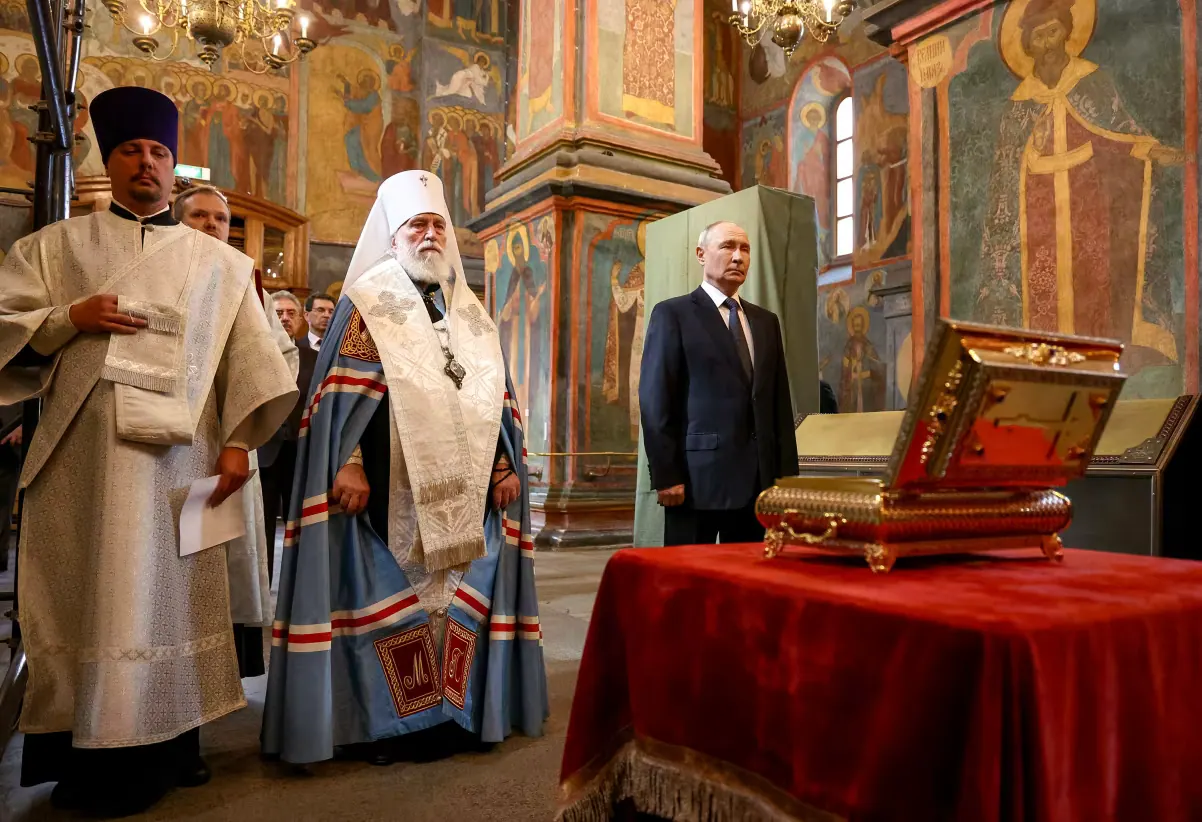
In a move that has sparked both curiosity and criticism, Russia has sent the remains of Prince Dmitry Donskoy, a medieval warrior prince, to troops fighting in eastern Ukraine. A fragment of Donskoy's right hand, which he used to wield his sword at the Battle of Kulikovo in 1380, was dispatched to the front lines in early September. The Russian Orthodox Church's military department stated that the "saint commander" would stand "shoulder to shoulder" with Russian soldiers, providing them with spiritual support.
The use of religious relics in this way is not unprecedented in Orthodox Christianity, but it has become a more pronounced tactic since Russia's full-scale invasion of Ukraine in 2022. The Kremlin has sought to portray its cause as "righteous" and divinely sanctioned, drawing on the country's strong Orthodox Christian heritage. According to Sergei Chapnin, a religious scholar, the relationship between the Kremlin and the Russian Orthodox Church has grown closer than ever, with the church "practically merged with the state to the point of being indistinguishable."
Donskoy's remains carry a specific message, experts say. He was a defender of the fatherland, not an aggressor, and his invocation serves to reinforce the idea that Russia is not the aggressor in the conflict. Chapnin described this as "a mobilizing myth" that can powerfully influence mass consciousness. The relics are presented as a kind of "magical artifact" that can boost morale and provide spiritual strength to soldiers.
The timing of sending Donskoy's remains into battle was also strategic. The prince's remains were uncovered during restoration work at the Kremlin's Archangel Cathedral in August, weeks after unverified reports that the relics of another medieval prince, Alexander Nevsky, had been lost. Russian Orthodox believers venerate the relics at Moscow's Cathedral of Christ the Saviour, where one of three reliquaries with the remains was displayed for public worship.
Not everyone views the use of Donskoy's remains as a genuine expression of faith. Rev. Alexander Zanemonets, an Orthodox priest and historian, described the discovery as "exploitation of Christianity and the exploitation of the church for 'patriotic' purposes." He argued that the use of the remains is a "cynical calculation" designed to shore up support for the state.
Despite these criticisms, many Russian soldiers have found comfort in their faith during the conflict. Soldiers have reported turning to God for support, and makeshift churches have been built near the front lines. Priests regularly visit military units and hospitals, providing spiritual guidance and comfort to those serving.
The Russian Orthodox Church's influence extends beyond the front lines, with large crowds participating in religious processions promoted by far-right and nationalist groups. In Moscow, over 100,000 people took part in a procession led by Patriarch Kirill, carrying a fragment of Donskoy's relics through the streets. According to Zanemonets, such events primarily serve to demonstrate the church's ability to mobilize large numbers of people in support of the state.
Key points
- Russia has sent relics of Prince Dmitry Donskoy to troops in Ukraine to boost morale and invoke religious symbolism.
- The use of relics is part of a broader effort by the Kremlin to portray its cause as "righteous" and divinely sanctioned.
- The relationship between the Kremlin and the Russian Orthodox Church has grown closer than ever, with the church providing significant support for the state.