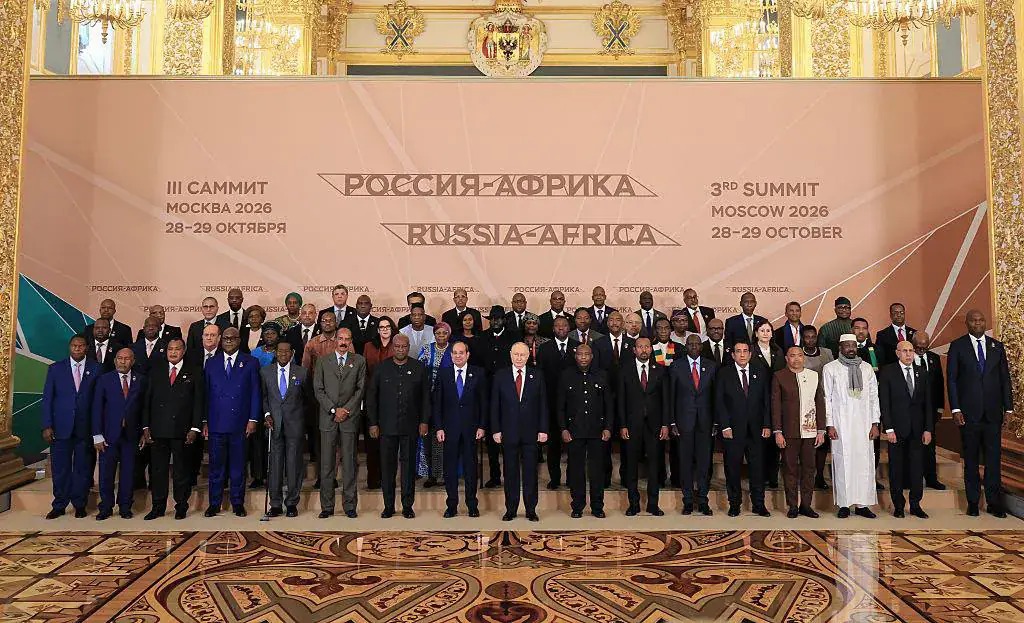
The Third Russia-Africa Summit was held in Moscow on October 28 and 29, with 22 African heads of state and government in attendance, alongside ministers, diplomats, and business representatives. Russian President Vladimir Putin and African Union Chairperson Évariste Ndayishimiye co-chaired discussions on the future of relations between Russia and the African continent. The summit covered various areas, including trade, investment, energy, agriculture, security, education, healthcare, technology, infrastructure, and political representation.
The summit resulted in a 101-point joint declaration, a separate declaration on cooperation in the civilian use of artificial intelligence, and a Russia-Africa Partnership Forum Action Plan covering 2027-2029. Russia presented itself as a partner willing to support African development, challenge the international order, and build relationships outside the traditional Western-led system. African governments came with their own priorities, including access to investment, technology, markets, energy, and opportunities to develop industries at home.
Despite the ambitious agenda, experts question what has actually changed for African countries after three Russia-Africa summits. The first summit was held in Sochi in 2019, followed by the second in St Petersburg in 2023, both producing declarations and promises of stronger cooperation. However, the continent should not measure its success by the number of leaders who attended or the language used in speeches, but rather by the economic progress made.
Russia has a genuine place in Africa's international relationships, with historical connections with liberation movements, diplomatic engagement with African governments, agricultural exports, and involvement in energy and security cooperation. However, the economic figures reveal a considerable gap between the political attention Moscow gives Africa and the scale of commercial relations between them. Russia-Africa trade was estimated at approximately $27 billion in 2025, below the $40 billion trade target announced in 2019.
In comparison, EU-Africa trade was approximately $395 billion and China-Africa trade was $348 billion in 2025, according to Chatham House. African countries should not abandon Russia, but the figures show that Russia remains a relatively smaller economic partner for the continent despite its growing political and security engagement. The promises made in Moscow need to be examined more carefully, particularly in supporting industrialization, developing infrastructure, expanding agricultural cooperation, and investing in energy.
The continent needs partners willing to support the development of local industries, manufacturing capacity, research institutions, technology, and skilled employment. An agreement to cooperate in mineral extraction is not necessarily a development breakthrough, but rather the capacity to process minerals, manufacture products, and retain a greater share of the economic value. The same applies to agriculture, where expanding trade in fertilizer, wheat, and other agricultural products may help address immediate needs, but African countries also need investment in agricultural processing, storage, machinery, research, and distribution.
The final declaration adopted in Moscow recognized some of these priorities, calling for the removal of trade barriers, increased exports of value-added African products, investment in local production, and the processing of mineral resources in the countries where they are extracted. African governments should now ask which projects will be funded, which companies will participate, where production will take place, how many jobs will be created, and when the public can expect results.
Key points
- Russia's economic engagement with Africa remains relatively small compared to other major partners.
- The continent needs partners willing to support the development of local industries and manufacturing capacity.
- The success of the Russia-Africa summit should be measured by the economic progress made, not just the number of leaders who attended.