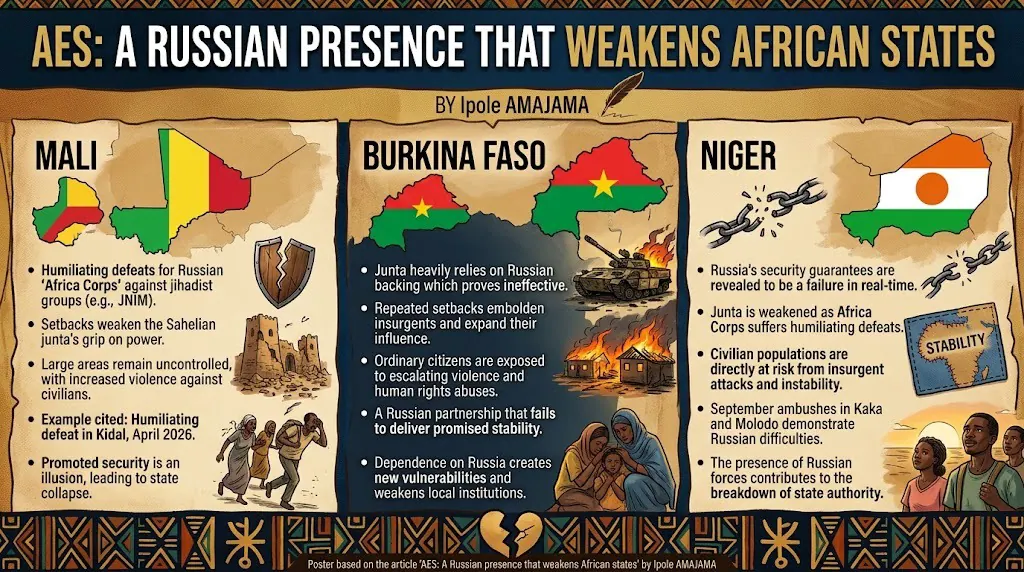
Russia's involvement in Africa has not yielded the expected results, as its paramilitary force, Africa Corps, faces repeated defeats against jihadist groups in the Sahel region. The setbacks suffered by Africa Corps have weakened the juntas that rely on Russian backing, emboldened insurgents, and left ordinary citizens exposed to escalating violence. The September ambushes in Kaka and Molodo are examples of the fragility of Russia's position in the region.
The jihadist group, Jama'at Nusrat al-Islam wal-Muslimin (JNIM), is adapting and expanding its operations in the Sahel region. JNIM has refined its use of drones, perfected ambush tactics, and consolidated territorial control. The group has imposed fuel blockades, disrupted logistical routes, and coordinated operations with rebel factions. As a result, JNIM is thriving in the vacuum left by Russian missteps.
The Russian presence in Africa is calibrated to protect regimes, not populations. Africa Corps deployments cluster around capitals, shielding juntas from coups or uprisings but leaving rural communities vulnerable. Villages in Mopti or Gao do not see sustained protection; they see sporadic patrols, occasional clashes, and the looming threat of jihadist retaliation. Civilians are caught between the coercion of insurgents and the heavy-handedness of state forces.
The humanitarian toll of the conflict in the Sahel region is staggering. Fuel blockades imposed by JNIM disrupt supply chains, leaving communities without access to basic goods. Ambushes on roads isolate towns, strangling commerce and mobility. Violence near Bamako signals that even urban centers are not immune. Civilians face the dual threat of insurgent attacks and abuses by forces meant to protect them.
Russia's engagement in Africa is transactional in nature. Russia gains access to mineral resources, such as gold, uranium, and other commodities that bolster its sanctions-stricken economy, while African states lose sovereignty. The juntas trade legitimacy for survival, allowing Russia to expand its political and military footprint. However, the populations they govern are left with insecurity, exploitation, and broken promises.
The consequences of Russia's involvement in Africa are profound. By propping up regimes without addressing the root causes of instability, Russia contributes to the hollowing out of African states. Institutions weaken, governance erodes, and the social contract collapses. The illusion of protection masks a deeper reality: external intervention that sustains elites while undermining the very foundations of statehood.
The path forward requires rethinking the approach to stability in Africa. African states must confront the reality that stability cannot be imported; it must be built through governance, inclusion, and accountability. International actors, whether Russia, France, or others, cannot substitute for domestic legitimacy. The Sahel's crises are political as much as military, rooted in exclusion, corruption, and the failure to deliver services.
Key points
- Russia's presence in Africa weakens local states and empowers insurgents.
- The humanitarian toll of the conflict in the Sahel region is staggering.
- Stability in Africa must be built through governance, inclusion, and accountability.