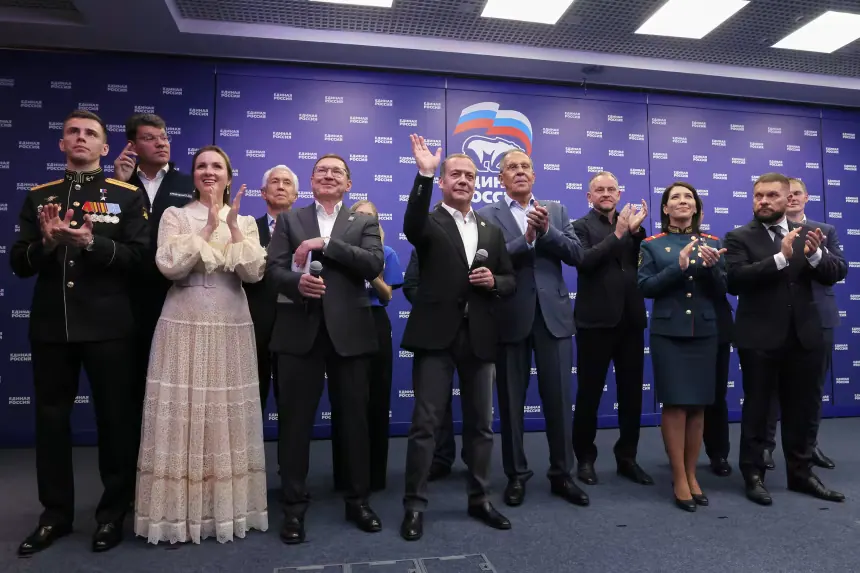
Russia's ruling United Russia party has won a resounding victory in the country's parliamentary election, which was widely expected given the lack of genuine opposition to the Kremlin. The party, which fervently backs President Vladimir Putin and Russia's war in Ukraine, secured a majority of seats in the parliament. This outcome was never in serious doubt, as the only remaining opposition party calling for an end to the war, Yabloko, was barred from participating in the election.
The election, which took place across 11 Russian time zones and in annexed regions occupied by Russian forces in Ukraine, was seen as a sign of normalcy by the Kremlin. This is important for the government as it grapples with an escalating war, soaring casualties on the front lines, mounting economic hardship, and rising public anxiety. The Kremlin has been at pains to reassure Russians that life goes on largely unaffected by the war, despite relentless Ukrainian drone strikes.
President Putin told Russians before the election that it would showcase national unity and that millions of people are backing the country's fighters in Ukraine. This confidence in the result was evident in the nationwide vote, which was used to underline that Russia, unlike Ukraine, is prepared to hold a vote in wartime. This may be seen as an attempt to curry favor with US President Donald Trump, who has criticized Kyiv's constitutional ban on elections during martial law.
However, what is far less certain than the outcome of the election is how the Kremlin will use its fresh veneer of political support and what course of action it will push next. One of the sharpest fears is that the Kremlin will use its claim of a fresh mandate to launch a new round of forced mobilization into the depleting ranks of the Russian military. A chaotic partial mobilization in September 2022 saw about 300,000 men called up, sparking widespread anger and a panicked exodus of hundreds of thousands of Russians.
The Kremlin has since tightened border controls, making it harder to flee, and dismissed concerns of a repeat as scaremongering. President Putin himself categorically denied there is a general call-up plan, lambasting the speculation as complete nonsense and an information attack on Russia. Given this personal insistence, the election is more likely to be used as evidence that Russia rewards its soldiers with plum political jobs, as a means of boosting voluntary recruitment.
In the election, 49 veterans of the Ukraine war were elected, highlighting the Kremlin's efforts to reward its soldiers. However, some cautious Russians of military age, fearing a U-turn, are leaving the country just in case, mindful that the dire need for fresh troops could eventually outweigh the Kremlin's urge to avoid public outrage. There are heightened concerns of other measures in the offing, from a renewed military push in Ukraine to further tightening of social and economic controls at home.
The Kremlin feels that the resounding parliamentary election result has delivered renewed authority to act. As pressure builds on Russia's war machine, it remains to be seen how the government will use its claimed mandate. The staging of a nationwide vote has been cast in Russia as a sign of normalcy, but the reality of the war is increasingly being felt by Russians. The Kremlin's next moves will be closely watched, both domestically and internationally.
Key points
- The Kremlin's use of the election result to launch a new round of forced mobilization is a major concern for Russians.
- The election result has delivered renewed authority to the Kremlin to act on its military objectives in Ukraine.
- The Kremlin's efforts to reward its soldiers with plum political jobs may boost voluntary recruitment.