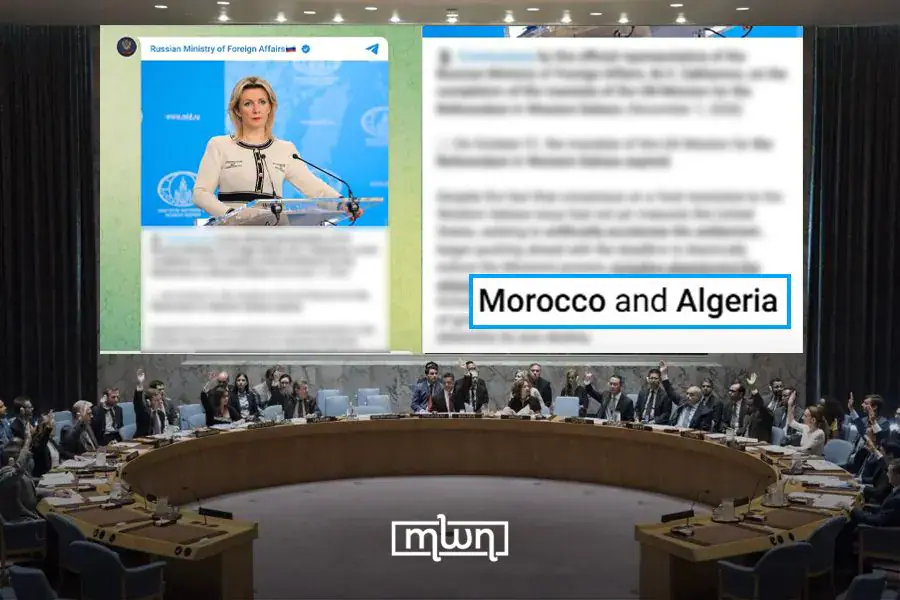
Russia's recent statement on the Western Sahara dispute has brought attention to Algeria's direct involvement. On November 1, Russian Foreign Ministry spokesperson Maria Zakharova explicitly named Algeria and Morocco as the two "directly concerned parties" to the dispute. This statement challenges Algeria's longstanding claims of being merely an observer and neighboring country.
The UN Security Council failed to adopt a resolution to renew the mandate of the peacekeeping operation MINURSO, which has been present in Morocco's southern provinces for 35 years. Russia vetoed a US-drafted resolution, which sought to rename MINURSO to MINUSO, removing the reference to a "referendum" from the mission's name. The US draft aligned with the growing international support for Morocco's Autonomy Plan.
Russia, a strategic ally of Algeria's regime, presented an alternative resolution to extend MINURSO's mandate, but it was vetoed by the US. The Russian redrafted resolution was only supported by three countries of the UNSC's 15 members. This led to the end of MINURSO's mandate on October 31, with Morocco's Royal Cabinet emphasizing that the mission's continued presence no longer made sense.
Morocco sees an opportunity in Russia's Security Council veto. The veto presents a chance for Rabat to show the international community that its diplomatic momentum has been growing and to highlight which parties are obstructing a final settlement to the dispute. Russia's statement emphasizes that the Polisario Front is merely a proxy seeking to serve Algeria's separatist project.
Russia's wording acknowledges Algeria's direct involvement in the dispute, rather than treating it as a mere observer. This marks another diplomatic setback for Algeria's regime and the Polisario. Moscow emphasized that it remains in close contact with its "Algerian and Moroccan" partners on the issue, explicitly naming Algeria and Morocco while referring to "other partners" without mentioning the Polisario Front.
Morocco's Permanent Representative to the UN, Omar Hilale, exposed the Algerian regime's double standards, stating that its response to the non-renewal of MINURSO's mandate showed the world that there are only two parties to the dispute: Morocco and Algeria. Hilale emphasized that Algeria's speech demonstrated its primary responsibility for the continuation of the dispute.
Morocco's Foreign Affairs Minister Nasser Bourita stated that the veto did not come as a surprise, as the country had anticipated it. He viewed the development as a strategic opportunity, emphasizing that the end of MINURSO reflects the reality on the ground, where the "R" and its reference to a "referendum" are no longer on the table, and only the Autonomy Plan remains the framework capable of resolving the dispute.
Key points
- Russia identifies Algeria as a 'directly concerned' party in Western Sahara dispute
- The UN Security Council failed to adopt a resolution to renew MINURSO's mandate
- Morocco views Russia's veto as a strategic opportunity to advance its diplomatic momentum