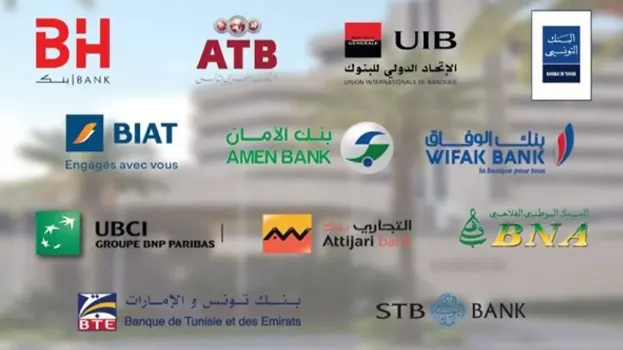
A recent study by Prime Partners Holding, based on financial data up to June 2026, reveals that 10 Tunisian banks listed on the Tunis Stock Exchange exhibited varied results for the first half of 2026. Seven banks recorded growth in their net profits, while two banks experienced a decline. Additionally, one bank shifted from profit to loss. The study highlights that the net banking income rose for 9 out of 10 banks.
The bank with the highest growth in net profit was Banque de l'Aménagement, with an increase of 23.7% to 161.9 million dinars. This was followed by the National Agricultural Bank, which saw a rise of 13.8% to 156.3 million dinars, and the Tunisian Bank, with a 12.5% increase to 95.6 million dinars. Other banks that recorded growth include the Tunisian Arab International Bank, the Commercial Bank, the International Union of Banks, and the Banking Union for Trade and Industry.
The Tunisian Arab International Bank's net profit rose by 10.3% to 271.4 million dinars, while the Commercial Bank saw a 5.9% increase to 123.1 million dinars. The International Union of Banks recorded a 6.6% growth to 52.3 million dinars, and the Banking Union for Trade and Industry saw a 9.7% rise to 30 million dinars. In contrast, the Housing Bank's net profit declined by 72% to 15.2 million dinars, despite an 8.7% increase in net banking income to 345.7 million dinars.
The Tunisian Company for Bank's net profit also decreased by 59.4% to 9.1 million dinars. Meanwhile, the Arab Bank for Tunisia shifted from a net profit of 2.6 million dinars in the first half of 2025 to a loss of 27.6 million dinars in the same period of 2026. The study attributes the decline in some banks' results to the increase in provisions allocated to cover loan risks.
The provisions for loan risks increased significantly for some banks, such as the Housing Bank, which saw a rise of 83.9% to 146.7 million dinars, and the Arab Bank for Tunisia, which increased from 32.7 million dinars to 68.6 million dinars. The study also highlights variations in the loan-to-deposit ratio among banks, ranging from 57.4% for the Tunisian Arab International Bank to 101.4% for the Housing Bank.
The ratio of classified loans also showed significant disparities, with the National Agricultural Bank recording 21.59%, while Banque de l'Aménagement and the Tunisian Bank reported 8.70% and 6.49%, respectively. The Banking Union for Trade and Industry had a ratio of 5.1%. These variations indicate differing levels of risk exposure among the banks.
The mixed results of the Tunisian banks listed on the stock exchange reflect the challenges and opportunities in the country's banking sector. While some banks have demonstrated resilience and growth, others have faced difficulties, highlighting the need for continued monitoring and analysis of the sector's performance. The study by Prime Partners Holding provides valuable insights into the financial health of Tunisian banks.
Key points
- Seven Tunisian banks listed on the stock exchange experienced growth in their net profits during the first half of 2026.
- Two banks saw a decline in their net profits, while one bank shifted from profit to loss.
- The increase in provisions for loan risks was a significant factor affecting the results of some banks.