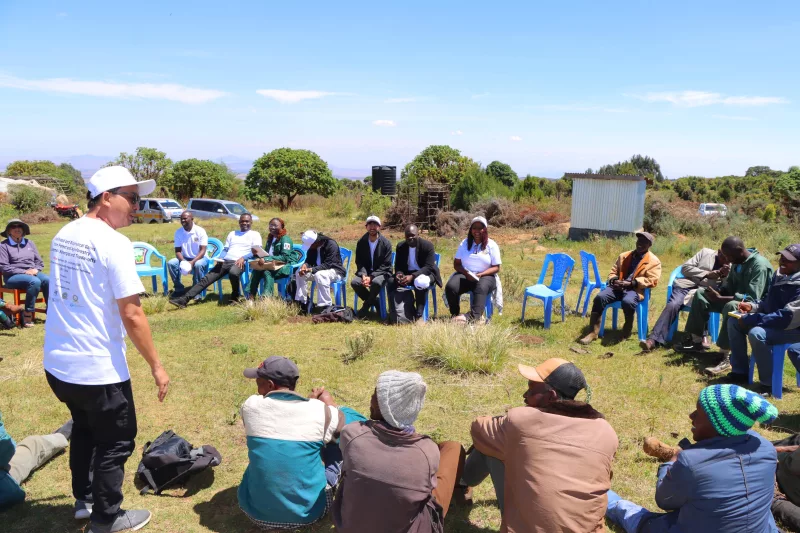
Researchers in Kenya are working to find a balance between forest conservation and community livelihoods. The study, led by Dr. Robert Mbeche of Jomo Kenyatta University of Agriculture and Technology (JKUAT), aims to examine how conservation efforts can protect biodiversity while supporting communities that depend on forests and their resources. The project brings together researchers from Africa, Germany, and Asia to share knowledge and expertise.
The research focuses on forests and agroforestry systems, which are under growing pressure from climate change, biodiversity loss, and changing land use. The researchers are seeking ways to protect forests and biodiversity without undermining the livelihoods of communities that depend on the same landscapes for food, livestock, and income. This involves examining the impact of management decisions on biodiversity, livelihoods, and environmental justice.
A five-day Summer School was recently hosted by JKUAT, bringing together over 20 doctoral and postdoctoral researchers from various institutions. The event provided a platform for researchers to share their experiences and examine the outcomes of different approaches to forest and agroforestry management. Participants noted that while efforts to address pressures on forests have varied in their success, a more integrated approach is needed.
The researchers are drawing on evidence from communities and landscapes to assess the impact of management decisions on biodiversity, livelihoods, and environmental justice. They are also developing indicators to measure the sustainability of different approaches to forest and agroforestry management. This involves fieldwork and data analysis to examine forest conditions, household dependence on natural resources, and governance arrangements.
Experts emphasize that conservation efforts must take into account the needs and interests of communities that depend on forests. Prof. Anja Faße of TUM Campus Straubing in Germany noted that efforts to protect forests must consider the people who depend on them, particularly when conservation measures affect access to land and natural resources. This requires a more nuanced approach to conservation that balances environmental and social concerns.
The researchers will use the training and field experience to strengthen their studies and develop research and policy outputs that can inform decisions on forest and agroforestry management. The broader aim is to generate evidence on where conservation and livelihoods can reinforce each other, while identifying the tensions that need to be addressed. This will help policymakers develop more effective strategies for managing natural resources.
The study is a collaboration between JKUAT, the University of Parakou, Joseph Ki-Zerbo University in Burkina Faso, Stellenbosch University in South Africa, and the Universities of Göttingen and Kassel in Germany. The research is supported by Germany's Volkswagen Foundation. The findings are expected to contribute to more sustainable and equitable management of natural resources in Kenya and beyond.
Key points
- Conservation efforts must balance environmental and social concerns to be effective.
- Researchers are developing indicators to measure the sustainability of different approaches to forest and agroforestry management.
- The study aims to generate evidence on where conservation and livelihoods can reinforce each other.