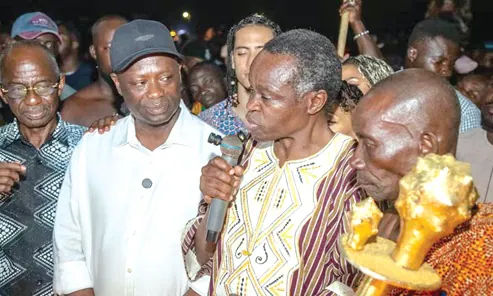
African leaders have been urged to return to the founding ideals of intercontinental unity by Ghana's first President, Osagyefo Dr Kwame Nkrumah. Prof. P.L.O. Lumumba, a renowned Pan-Africanist and Kenyan legal luminary, made the call at this year's NkrumahFest celebration in Nkroful, the birthplace of Dr Nkrumah in the Western Region of Ghana. The event, held on September 17, 2026, marked the 117th birthday of Dr Nkrumah and was attended by various dignitaries, including the Paramount Chief of Essikado Traditional and President of the Western Regional House of Chiefs, Nana Kobina Nketsia V.
Prof. Lumumba described the current state of Africa as a betrayal of Nkrumah's vision of a united Africa, which must be reversed. He noted that 66 years after independence, Africa remained politically divided and economically colonized amid its enormous natural resource endowment. According to him, Nkrumah's vision for a united, dignified Africa remained relevant and intergenerational decades after his death. Prof. Lumumba described Dr Nkrumah as one of the greatest Africans to have lived, saying his contribution to the liberation and dignity of Africa went far beyond his country of birth, Ghana.
The NkrumahFest celebration, an annual heritage and cultural festival, was spearheaded by the Member of Parliament (MP) for Ellembelle, Emmanuel Armah-Kofi Buah. The event saw the unveiling of a roundabout with the statue of Dr Nkrumah in the Ellembelle District in the Western Region. The celebration, which started on September 16, 2026, was attended by various guests from different parts of the country and the world, including Dr Matthew Opoku Prempeh, the former running mate of the New Patriotic Party (NPP) in the 2024 general election.
Prof. Lumumba recalled Nkrumah's advocacy for African unity, including his role in the establishment of the Organisation of African Unity (OAU), now the African Union, in 1963 in Addis Ababa, Ethiopia. He also recalled the historic moment when Nkrumah warned that if African countries failed to unite, the forces that had previously colonized the continent could return in different forms. According to Prof. Lumumba, Nkrumah's book "Africa Must Unite" reflected his strong conviction that African countries needed to work together to protect their independence and sovereignty.
Prof. Lumumba linked Nkrumah's Pan-African vision to the civil rights struggle in the US, saying Ghana became an important source of inspiration for leaders such as Martin Luther King Jr., among many others. He noted that although Nkrumah's political career was cut short following the 1966 coup, attempts to suppress his legacy could not extinguish his ideas even after death. The remains of Dr Nkrumah were first interred in Guinea, moved to Nkroful, and later to the current resting place in Accra.
The convener of the event, Mr Buah, who is also the Minister of Lands and Natural Resources, said Nkrumah's legacy should inspire renewed commitment to self-determination, Pan-Africanism, and shared prosperity, particularly among the younger generation. He noted that during Nkrumah's regime, the country saw the establishment of major institutions of learning, infrastructure projects such as the Akosombo Dam, the Tema Harbour, the Adomi Bridge, and factories, among many other investments which could best be described as intergenerational.
The NkrumahFest celebration is a testament to the enduring legacy of Dr Nkrumah, and the event has been ongoing for several years. The event was broadcast live on various radio stations, including Asaase Radio, which has a wide reach across Ghana. The radio stations provided live updates and commentary on the event, highlighting the significance of Nkrumah's vision and legacy.
Key points
- African leaders must heed Nkrumah's vision of unity to reverse the continent's current state of political division and economic colonization.
- Prof Lumumba described Nkrumah's vision for a united Africa as relevant and intergenerational decades after his death.
- The NkrumahFest celebration aims to promote Nkrumah's legacy and inspire renewed commitment to self-determination, Pan-Africanism, and shared prosperity.