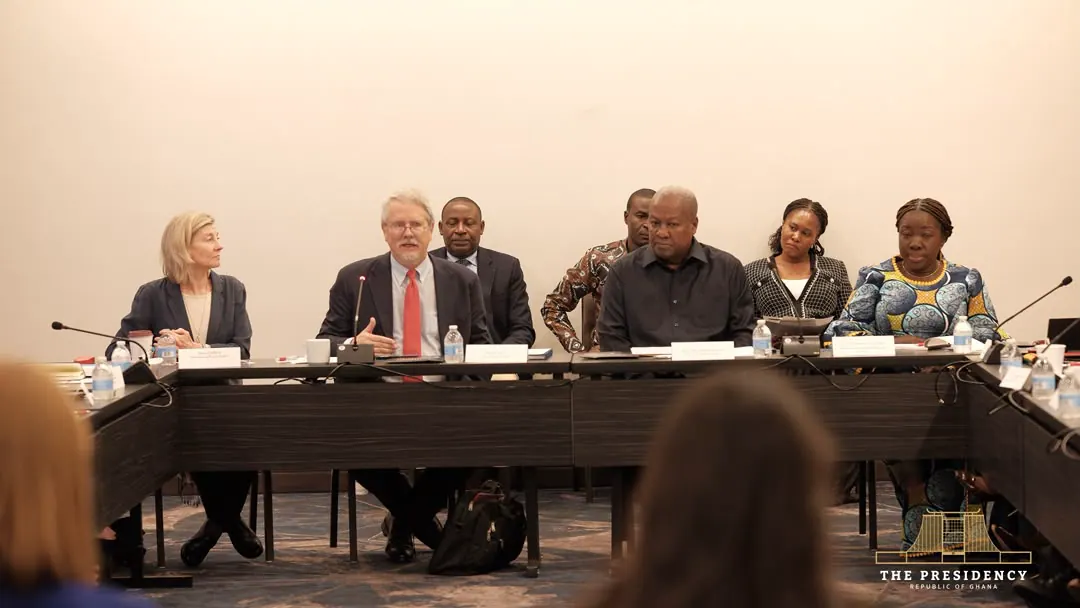
President John Dramani Mahama has called for a new global development bargain that gives countries in the Global South greater control over their health and development priorities. Speaking at a high-level side event on the Accra Reset: Global Reset Dialogue on the sidelines of the 81st United Nations General Assembly in New York, President Mahama emphasized the need for stronger accountability from national governments. He argued that countries could no longer be expected to “own” development outcomes when key decisions over financing, programme design and implementation remained outside their control.
President Mahama identified three interconnected challenges facing the Global South: geostrategic marginalisation, geopolitical vulnerability and donor dependence. These challenges, he said, continued to constrain the development choices of countries in the region. To address these challenges, President Mahama stressed the need for a stronger link between political authority, productive capability and financial resilience. This, he believes, will enable the Global South to move beyond dependence on external financing and build the capacity to determine and sustain its own development priorities.
The Accra Reset, according to President Mahama, is founded on the recognition of the need for a new global development bargain. He drew parallels between the Accra Reset and Ghana’s domestic Resetting Ghana Agenda, which focuses on economic self-reliance, local value addition, stronger public health infrastructure, transparent governance and the 24-Hour Economy initiative. President Mahama emphasized that Ghana’s domestic transformation could not be separated from the wider global system, stressing that domestic discipline and global reform must advance together.
On health, President Mahama advocated for a shift in approach, going beyond building hospitals and relying on external partners for essential medicines and supplies. He proposed increased domestic pharmaceutical production, supported by guaranteed state purchasing and access to regional markets. This approach, he believes, will strengthen local and regional capacity in research, manufacturing, regulation, financing and distribution. The Accra Reset’s global health agenda is built around this principle, seeking to empower countries to take control of their health priorities.
President Mahama challenged the long-standing development model under which countries were expected to take ownership of programmes while key decisions remained in the hands of external partners. He referred to the 1955 Bandung Conference and the subsequent evolution of international development cooperation, arguing that political independence had not always been matched by control over the systems that shape global trade, finance and health. He therefore declared that “there can be no ownership without control.”
The President cautioned that greater control must be matched by accountability, emphasizing the need for countries to be responsible with the power and resources they have. He also highlighted the importance of partnerships and collaboration in achieving the goals of the Accra Reset. According to President Mahama, the Global South must work together to build a more equitable and sustainable development model that prioritizes the needs and aspirations of its people.
The Accra Reset: Global Reset Dialogue is a high-level side event that seeks to promote a new global development bargain that prioritizes the needs and aspirations of countries in the Global South. President Mahama’s call for greater control over health and development priorities resonated with participants, who emphasized the need for a more equitable and sustainable development model. The event provided a platform for leaders to discuss the challenges facing the Global South and explore solutions that promote economic self-reliance, local value addition and stronger public health infrastructure.
Key points
- President Mahama calls for a new global development bargain that gives countries in the Global South greater control over their health and development priorities.
- The Accra Reset seeks to address three interconnected challenges facing the Global South: geostrategic marginalisation, geopolitical vulnerability and donor dependence.
- President Mahama advocates for increased domestic pharmaceutical production and regional cooperation to strengthen local and regional capacity in research, manufacturing, regulation, financing and distribution.