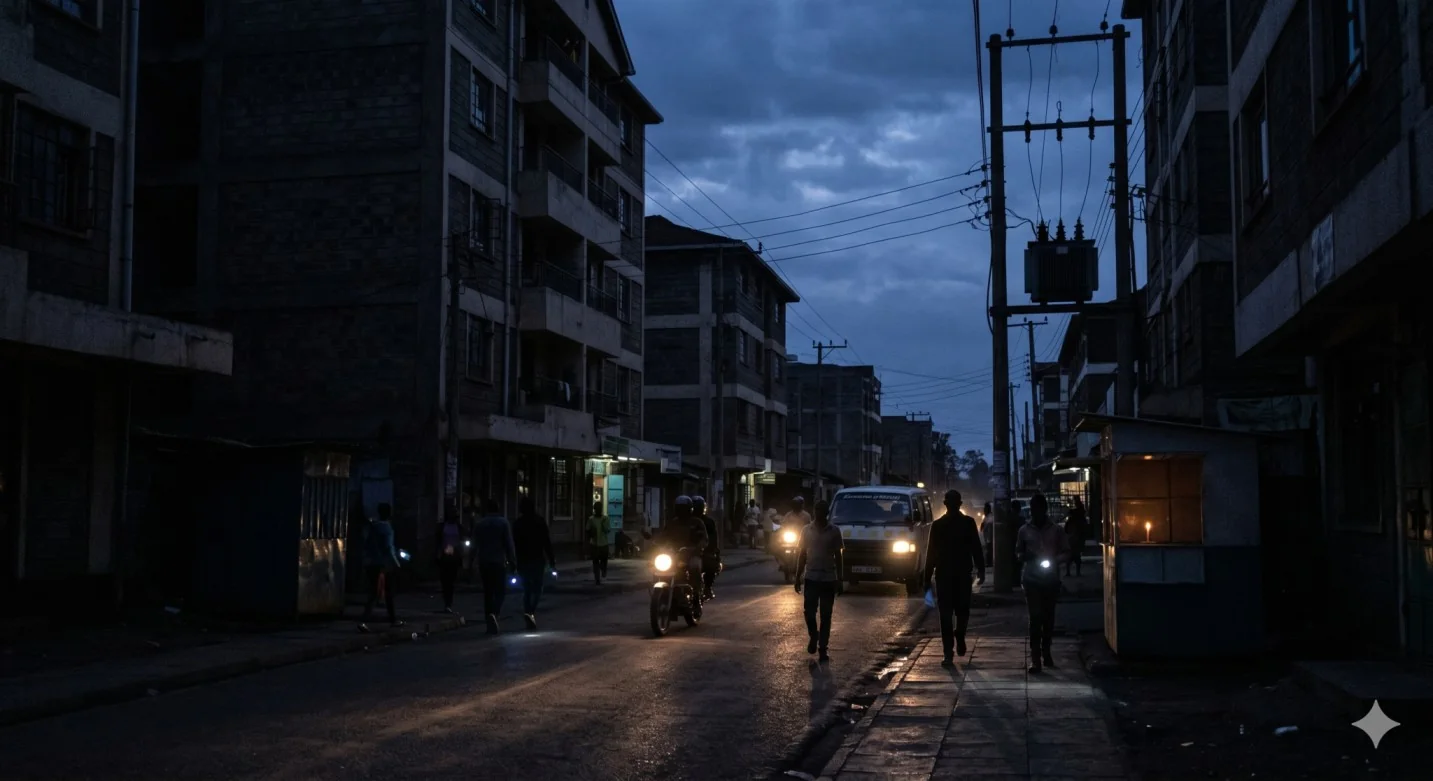
Kenya experienced a significant decline in power supply reliability in the year ended June 2026, with customers facing longer outages and more interruptions. According to the Energy and Petroleum Regulatory Authority (EPRA) report, the average customer experienced 3.91 power interruptions every month, compared with 3.67 recorded in the previous financial year. The average outage lasted 3.23 hours, representing an increase of 39.6 minutes from the 2.57 hours reported in the year ended June 2025.
The duration of power outages in Kenya worsened in May 2026, with interruptions lasting 5.49 hours, the longest average outage duration recorded. In contrast, September 2025 recorded the shortest average outage at 2.11 hours. The Customer Average Interruption Duration Index (CAIDI) increased to 3.23 hours during the financial year, against the regulatory target of 1.36 hours for the 2025/26 tariff control period. CAIDI measures the average duration of an interruption among customers who experienced a sustained outage.
The CAIDI figure has been rising over the five-year period, from 2.25 hours in 2022/23, 2.53 hours in 2023/24, 2.57 hours in 2024/25, and 3.23 hours in 2025/26. This upward trajectory conflicts with regulatory goals, which aimed for a gradual decrease in the index toward regional benchmarks by June 2026. Despite meeting the regulator's CAIDI target in earlier years, the utility missed the requirement in each of the last two years.
The amount of time customers spent without electricity also increased sharply during the year. EPRA recorded an annual System Average Interruption Duration Index (SAIDI) of 13.16 hours, compared with 9.24 hours in the year ended June 2025. The increase of 3.74 hours pushed annual SAIDI to its highest level in the five-year period. SAIDI measures the average total duration of interruptions affecting customers connected to a distribution network.
May recorded the highest monthly SAIDI at 27.33 hours, followed by June at 19.77 hours and March at 17.51 hours. July 2025 had the lowest monthly figure at 7.18 hours. The annual SAIDI figure of 13.16 hours was above EPRA's 1.5-hour target. The regulator said the index remained above its threshold and the regional benchmark throughout the five-year period.
While power reliability weakened, the report recorded an improvement in system losses. System losses declined to 21.38 per cent in the year ended June 2026 from 23.36 per cent a year earlier. EPRA said this was the lowest level recorded during the five-year period. System losses cover electricity lost through both technical and commercial means during transmission and distribution.
Despite the drop, the 21.38 per cent loss rate was still 488 basis points above the 16.5 per cent level allowed by EPRA for the 2025/26 tariff control period. The utility continued to miss EPRA's annual system-loss targets throughout the period covered by the report. The regulator had set the target at 19.5 per cent between 2021 and 2023, before lowering it to 18.5 per cent in 2023/24, 17.5 per cent in 2024/25, and 16.5 per cent in 2025/26.
Key points
- Kenya's power supply reliability deteriorated in the year ended June 2026.
- The average customer experienced 3.91 power interruptions every month.
- System losses declined to 21.38 per cent in the year ended June 2026.