Egypt is preparing a national strategy to develop its data-centre industry, leveraging its strategic location and telecommunications infrastructure to become a larger economic opportunity. The strategy, expected to be launched by the end of 2026, will address key requirements for developing the industry, including investment incentives, energy availability and pricing, licensing procedures, and infrastructure readiness. This move is part of Egypt's efforts to turn its advantages into greater economic value by hosting and processing data, attracting data centres and cloud services, and developing applications.
The national strategy is being prepared in line with directives from President Abdel-Fattah Al-Sisi and is expected to address the main challenges facing investors, including tax incentives, electricity availability and costs, and licensing procedures. Amr Abbas, vice president of the National Telecom Regulatory Authority (NTRA), stated that the period from 2027 to 2030 would mark Egypt's transition from being primarily a transit route for telecommunication cables to becoming an international hub for data centres. A joint venture called Africa Data Centres Egypt has been established by Vodafone Business, Elsewedy Electric, and Cassava Technologies to develop data-centre and sovereign AI infrastructure in Egypt.
The project is expected to start with 20 MW of capacity and eventually scale up to 200 MW, while the first phase could attract up to $200 million in foreign direct investment (FDI). A separate Vodafone-Cassava partnership will develop Egypt's first data centre dedicated to sovereign AI and provide local access to advanced technologies. This development is driven by the increasing importance of data centres to the expansion of artificial intelligence (AI), cloud computing, and the wider digital economy.
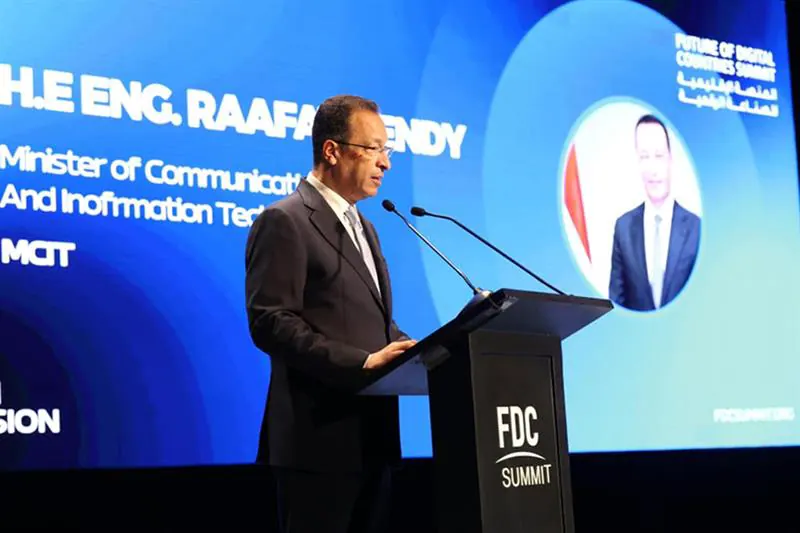
A delegation from US technology company Nvidia visited Egypt, expressing interest in the country's potential to become a regional AI hub. Nvidia's vice president for Europe, the Middle East, and Africa, Paolo Guglielmini, noted opportunities to accelerate investment in infrastructure and computing and expand public-private sector cooperation. Minister of Communications and Information Technology Raafat Hendy emphasized that data centres have become one of the main arteries of the digital economy, hosting data, operating digital services, and supporting AI and advanced computing applications.
Egypt's geographical position and telecommunications infrastructure give it an important advantage in developing the sector. Around 20 international submarine cables pass through Egypt, carrying about 90 per cent of Internet traffic between Europe and Asia. The government's objective is to turn this advantage into greater economic value by hosting and processing data, attracting data centres and cloud services, and developing applications and exporting digital services to regional and global markets.
Industry experts highlight the need for investment in infrastructure, energy, and human resources to support the development of data centres. Hisham Mehran, CEO of Orange Egypt, identified infrastructure, energy, and human resources as the three main pillars for Egypt to become a leading regional hub for AI. Mehran emphasized the importance of clean energy, particularly solar power, and encouraged investors to build renewable-energy plants to support the wider infrastructure ecosystem.
The development of data centres is also linked to cybersecurity, data protection, and digital identity. Tarek Shabaka, chairman of the FDC Summit organising committee, stressed the importance of data protection and the responsible use of AI and digital trust in the sector. With the national strategy and investments in data centres, Egypt aims to become a major player in the digital economy and a regional hub for data centres.
Key points
- Egypt is preparing a national strategy to develop its data-centre industry, driven by its strategic location and telecommunications infrastructure.
- A joint venture called Africa Data Centres Egypt has been established to develop data-centre and sovereign AI infrastructure in Egypt, with potential investment of up to $1 billion.
- Industry experts emphasize the need for investment in infrastructure, energy, and human resources to support the development of data centres in Egypt.