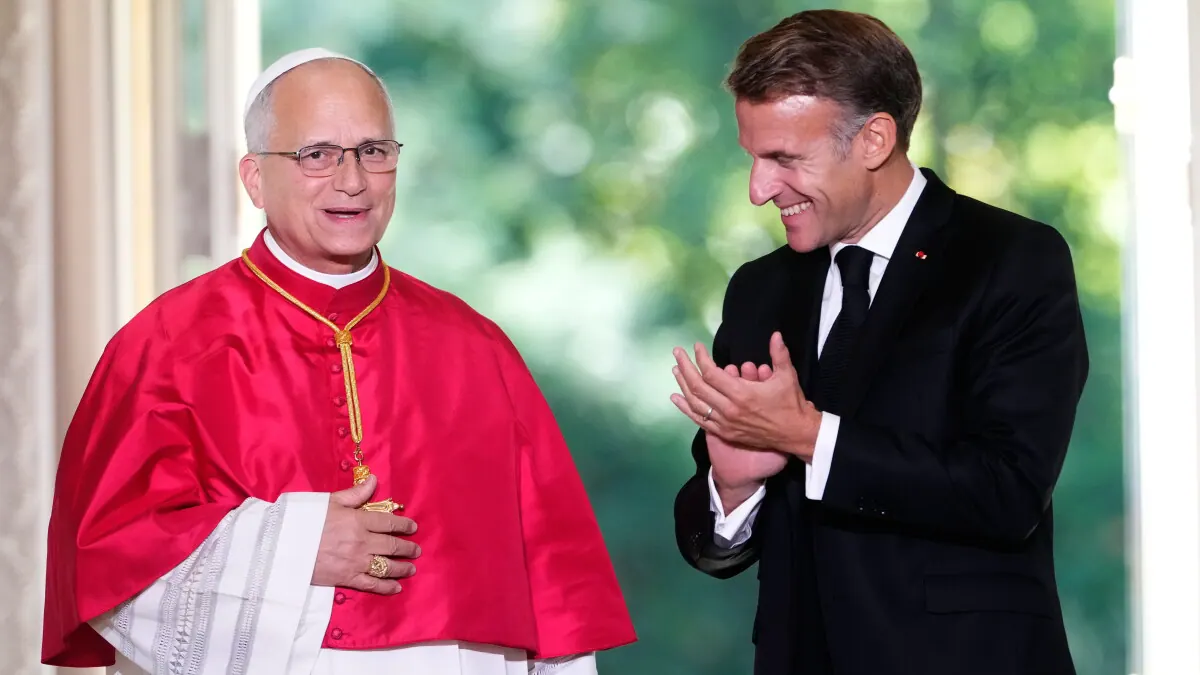
Pope Leo XIV began his four-day visit to France by addressing President Emmanuel Macron and other authorities at the Élysée Palace, posing fundamental questions about what it means to be human in the age of artificial intelligence and nuclear threats. He expressed concerns about the impact of scientific progress on humanity and reaffirmed the Vatican's opposition to nuclear weapons, stating that the nuclear deterrence doctrine is "mistaken" as it fuels a new arms race. Leo emphasized that peace is not achieved through a balance of power, but through dialogue and justice.
During his speech at the UNESCO headquarters, Leo raised existential concerns about the threats to human life and dignity. He highlighted the importance of recognizing the inalienable dignity of human persons, whose lives should not be judged solely by efficiency. The Pope's visit comes at a time when the French Catholic Church has lost influence due to the country's strict secularism. Despite this, over a million people are expected to turn out to see him, with many lining the streets of Paris as his motorcade passed by.
Macron welcomed Leo's visit, saying it brings "a source of hope" to many French people. He emphasized France's commitment to peace, multilateralism, and respect for international law. For Macron, who is nearing the end of his term, hosting the Pope is seen as a significant event, particularly given his low approval ratings. Charles Mercier, a historian, noted that Macron may be seeking to capitalize on the Pope's popularity.
Leo's visit marks the first official state visit by a Pope in 18 years. He is seeking to reawaken Europe's Christian roots and emphasize the value and dignity of human life. This is in contrast to his predecessor, Pope Francis, who focused on visiting small Catholic communities. Leo's message is particularly relevant in France, where the right to abortion was enshrined in the constitution in 2024, and a bill allowing assisted dying was recently passed.
The Pope's concerns about human dignity and life extend to the threats posed by artificial intelligence. He has identified AI as one of the greatest challenges facing humanity and dedicated his first encyclical to the topic, calling for robust regulation and a focus on the common good. Leo appealed to AI developers and regulators to slow down and consider the ethical implications of their work.
Leo's message appears to be resonating with some AI companies, which have taken steps to address his concerns. The Pope expressed hope that the dialogue between the Vatican and tech companies will continue. He emphasized the need for education in ethical discernment to avoid losing humanity amid the increasing presence of machines in daily life.
The Rev. Aristide Ahidote, from Ivory Coast, who planned to attend the Pope's vespers service in Notre Dame, expressed admiration for Leo's vigor and strength. Despite the decline of the French Catholic Church, Ahidote noted that it still has a dedicated following. KEY_POINT: The Pope's visit aims to reawaken Europe's Christian roots and emphasize the value and dignity of human life. KEY_POINT: Leo has identified AI as one of the greatest challenges facing humanity and is calling for robust regulation. KEY_POINT: The Pope's message is seen as a source of hope for many French people, particularly given the country's current challenges.